
ROAD WARRIOR IMITATORS OF THE 80s
Who doesn’t love the post-apocalyptic sci-fi films of the 1980s? If you define the subgenre broadly, you’ll count at least 100 such films. They include post-nuke films and post-pandemic films. They also include Road Warrior imitators.
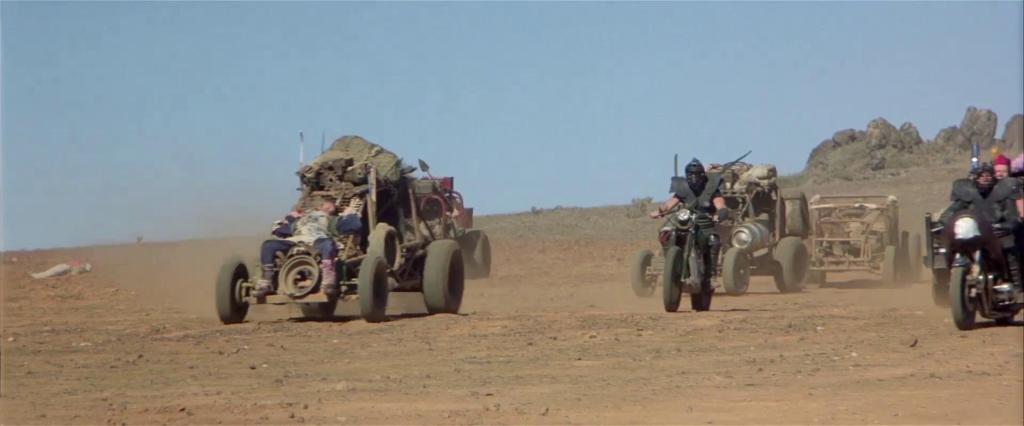
I’d like to cover these Road Warrior imitators; that is, post-apocalyptic films that obviously owe a large debt to George Miller’s 1981 masterpiece.
Compared with some other “imitation” subgenres that I’ve covered in this column (like Carrie imitators or Alien imitators), these Road Warrior imitators are a surprisingly strong bunch. Many are extremely low budget, and many are from Italian or Filipino filmmakers famous for their lack of originality, but all of them deliver what they promise.
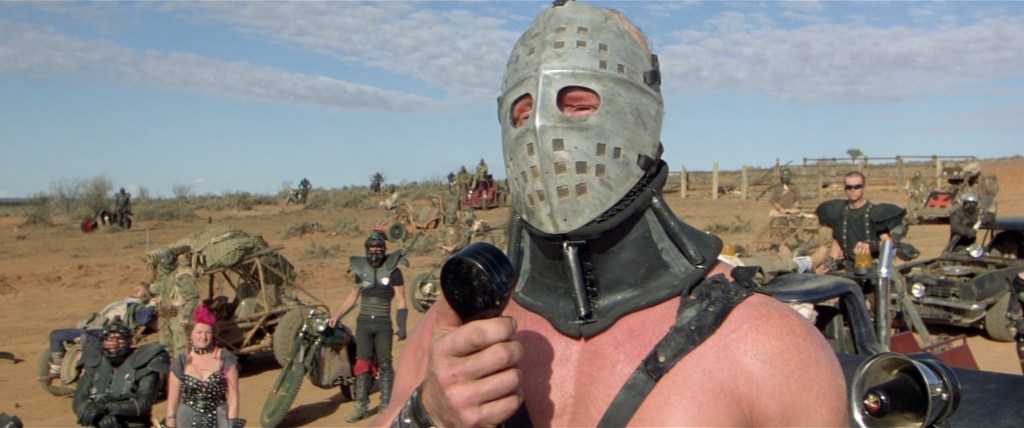
If your priority is watching ragtag gangs with punk leather outfits and armored vehicles fight each other in a sparsely populated wasteland, then you simply can’t go wrong with any of the films on this fairly long list.
The Road Warrior was a critical and popular success when first released in late 1981 and early 1982, and thus the first imitators appear around mid 1982.
The Road Warrior grew increasingly popular on home video, so it was no surprise that Beyond Thunderdome became an even bigger hit when it appeared in mid 1985. Though Beyond Thunderdome was clearly inferior to its predecessor, its influence can be easily discerned in the later imitator films that feature duels, makeshift towns, and prominent female characters.
We should note that the post-apocalyptic subgenre can be traced as far back as Roger Corman’s Day the World Ended (1955) or Ray Milland’s Panic in Year Zero! (1962). More immediate predecessors include A Boy and His Dog (1975) and maybe Deathsport (1978). Then of course there was Mad Max itself (1979).
So The Road Warrior did not define the subgenre of post-apocalyptic sci-fi films; instead it defined its own sub-subgenre within it.
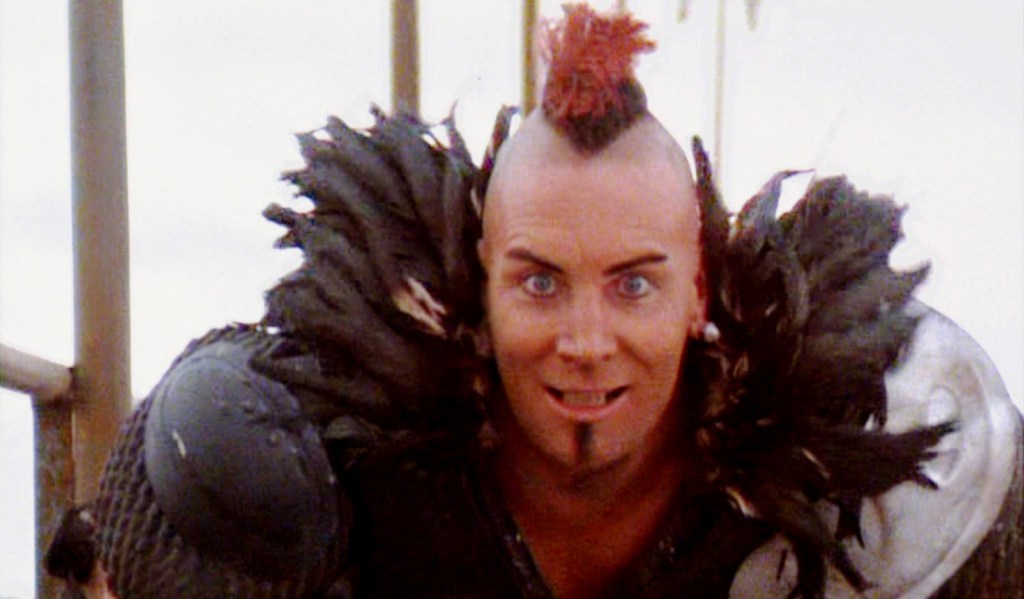
Let’s lay out 10 hallmarks of the Road Warrior imitator subgenre and then get to the very fun films.
Note: I’m skipping parodies like She (1982), America 3000 (1986), Interzone (1987), and Hell Comes to Frogtown (1988). I’m also skipping space opera versions like Metalstorm (1983) and Spacehunter (1983).
THE HALLMARKS:
1. DESERT SETTING. The Road Warrior immediately distinguished itself from Mad Max by setting itself in a desert rather than a city or town (even a dying one).
Though several imitator films have episodes in a forest or jungle, most are at least partly based in a desert wasteland. Deserts give a sense of deprivation, which is our next feature.
2. DEPRIVATION. Most imitators feature factions warring for a scarce resource such as gas in The Road Warrior, water in Stryker or Exterminators of the Year 3000 or Steel Dawn, uranium in A Man Called Rage, the unnamed refined resource from 2020 Texas Gladiators, or gunpowder in Raiders of the Sun.
Clothes, food, and supplies are likewise scarce. Most characters wear ragged or ripped clothes, and most appear soiled and unkempt.
3. RAGTAG GANGS. This goes with the deprivation. Unlike Mad Max which suggested some remnant of authority, The Road Warrior suggested a wasteland with no central government, legitimate or otherwise. There is a sense of chaos and danger.
In a few films, such as Endgame, a faction is able to control a single city. Usually, neither the good factions nor the evil ones control more than a bunker-like headquarters or fenced-in farm.
Yet amidst the ragtag deprivation, many gang members manage to exhibit a quasi-punk style: fancy leather straps, decorated hats, clips, feathers, makeup, or something stylized and funky.
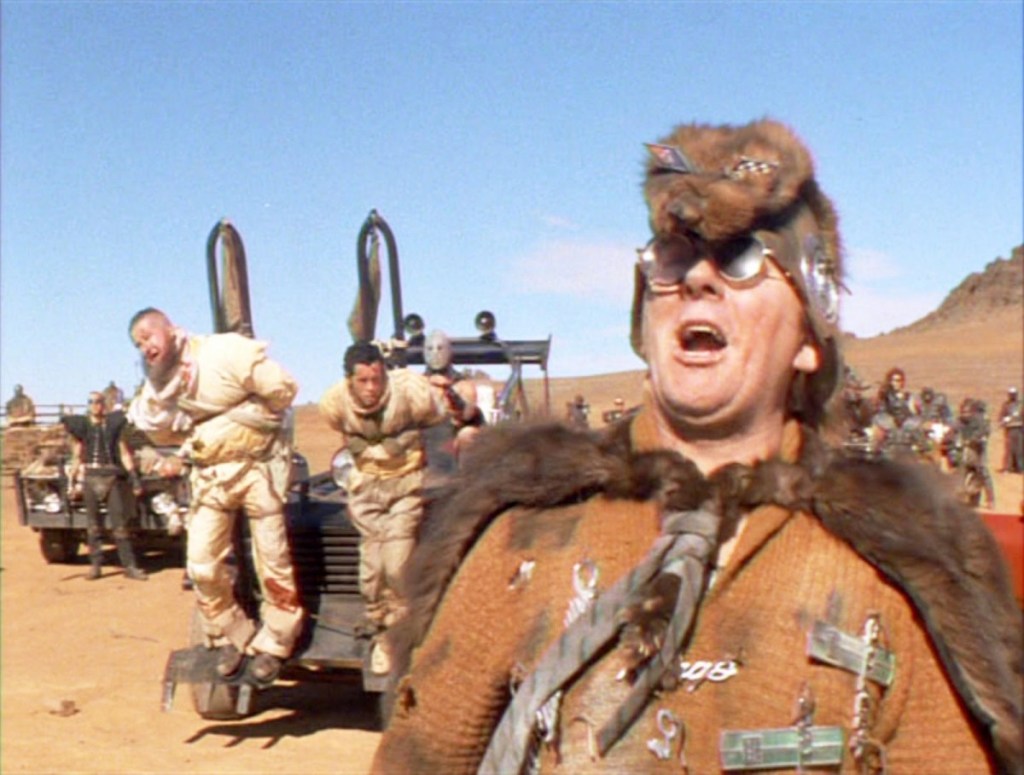
4. DECKED OUT ARMORED CARS. An obvious feature of a Road Warrior imitator is a combo car chase/car battle with the cars themselves modified to look tough and stylized on screen.
Even the cheapest of the imitators (like A Man Called Rage, Mad Warrior, or The Sisterhood) show some attempt to modify a car with armor or spikes or some kind of unusual decoration.
But this staple – the road action – is usually underplayed in the films, probably because everyone knew it would be impossible to match The Road Warrior at this level. Indeed, 40+ years later, only Mad Max: Fury Road might beat it.
5. SINGLE NAMES. Like Humongous from The Road Warrior, the bad guys have names like Scourge from Wheels of Fire, Prossor from Warrior of the Lost World, Rex from Mad Warrior, Slash from A Man Called Rage, Slater from Land of Doom, Trapper from Warriors of the Apocalypse, or Boarhead from Raiders of the Sun.
The good guys have single names like Stryker, Alien, Rush, Rage, Trace, Halakron, Nomad, or Slade. Speaking of good guys…
6. TRAGIC LONER HEROES. Genre films (especially Westerns) have long featured tragic loner heroes. But in Road Warrior imitators, the loners are a special type: like Max Rockatansky they wear black leather to connote their inner darkness, and like Max they are forever haunted by the murders of family members or loved ones.
In very rare cases a hero has a relative (like Stryker’s brother from Stryker or Trace’s sister from Wheels of Fire) but even then the heroes spend most of the movie alone.
In virtually every single imitator, the hero rides off alone at the end, even when a loving woman or a welcoming society implores him to stay.
7. MISOGYNY. The Mad Max movies don’t feel misogynistic, so I’m not sure where this came from, but in all the first Road Warrior imitators, women are little more than objects to be brutalized or raped. In DefCon-4 they are traded like commodities.
By the mid 80s, after Beyond Thunderdome, several movies featured women who could fight… but the fighting women are usually killed (as in Rush, Wheels of Fire, or Dune Warriors).
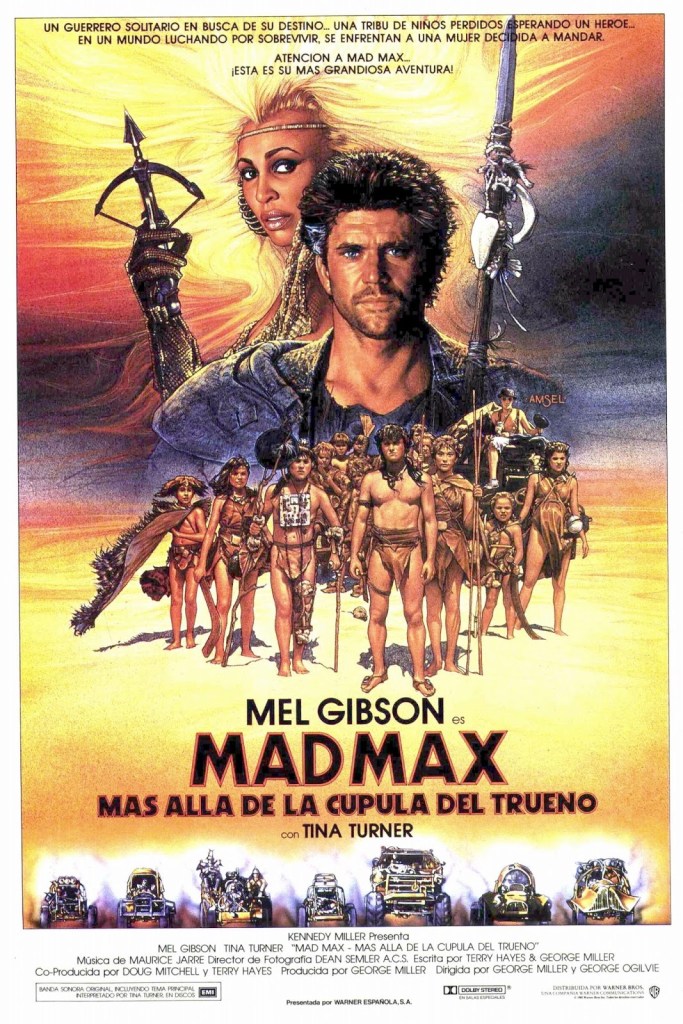
Some imitators featured women who could hold their own ground, but even then most were sexualized on screen (2020 Texas Gladiators, Exterminators of the Year 3000, A Man Called Rage, Land of Doom, Phoenix the Warrior, Raiders of the Sun, The Sisterhood).
8. INNOCENT PRIMITIVES. This comes mostly from Beyond Thunderdome influence, though some of the imitators preceded it.
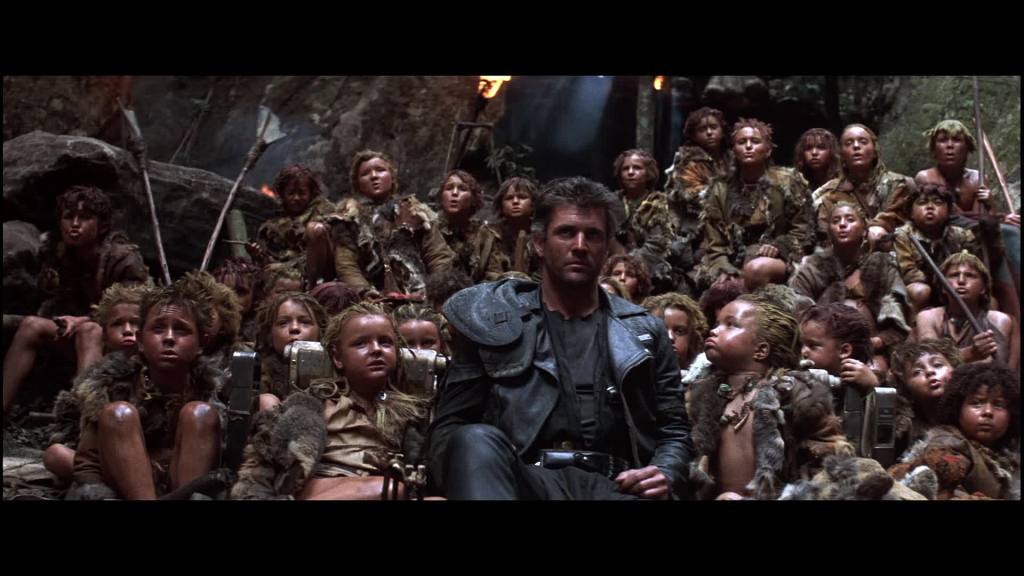
As Max meets the tribe of innocent, primitive, tough adolescents in Beyond Thunderdome, many heroes in Road Warrior imitators encounter a tribe of ethnics who first seem menacing but soon reveal to be stoic, honorable, and helpful.
These include the Indians from 2020 Texas Gladiators, the Mountain People in Equalizer 2000, the dwarves in Stryker, the Jawas from Land of Doom, and the “horse people” in A Man Called Rage.
9. DUELS. These are duels among people, not vehicles. Again this seems to come from Beyond Thunderdome influence. Most duels are one-on-one in a demarcated enclosure.
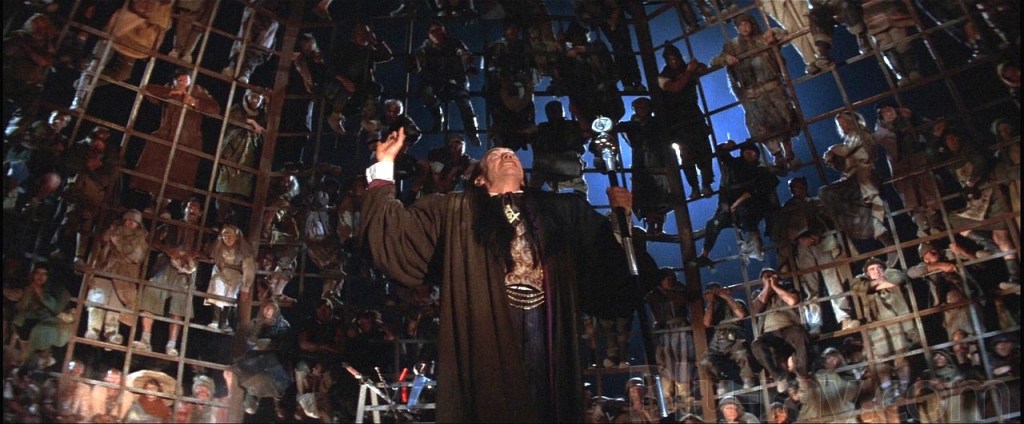
In the films, these duels give the heroes a chance to prove themselves. Most are well choreographed, so these duels are often highlights of the films.
These duels include the proof-of-courage in 2020 Texas Gladiators, the arena bouts in Mad Warrior, the hunts in Endgame, the anything-goes fistfight in Warrior of the Lost World, the fistfight at the temple in Warriors of the Apocalypse, the club combat in Wheels of Fire, the motorbike joust in Dune Warriors, and the rope initiation in Raiders of the Sun.

10. FIRE. This is a relatively minor convergence, but nearly all Road Warrior imitators feature flamethrowers or firebombs or some kind of flame weapons. Maybe it’s because vehicles run on gasoline, and gasoline is flammable. Flame weapons get used even in the films where gasoline is scarce. I guess bullets are even scarcer.
THE FILMS:
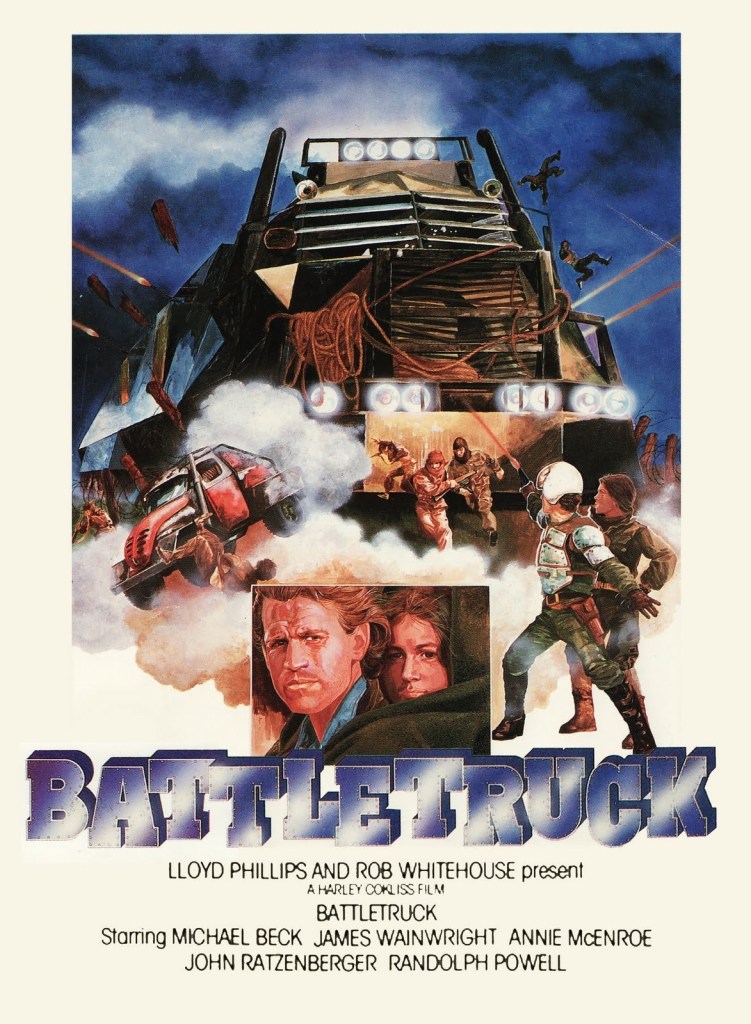
BATTLETRUCK (“Warlords of the 21st Century,” New Zealand, April 1982). Shortly after Road Warrior was a hit in Australia in late 1981, Battletruck got commissioned in nearby New Zealand. It was planned, written, shot, and released within months.
The titular armored tractor-trailer looks good, but it scarcely figures into the action until the climax. Michael Beck (The Warriors) is likeable, but he looks too lithe and elfin to play a gritty motorcycle loner.
It’s nobody’s favorite.
Still, if you don’t expect too much, you can enjoy the bleak landscapes and roadscapes. Bonus: John Ratzenberger from Cheers plays a sweet mechanic.
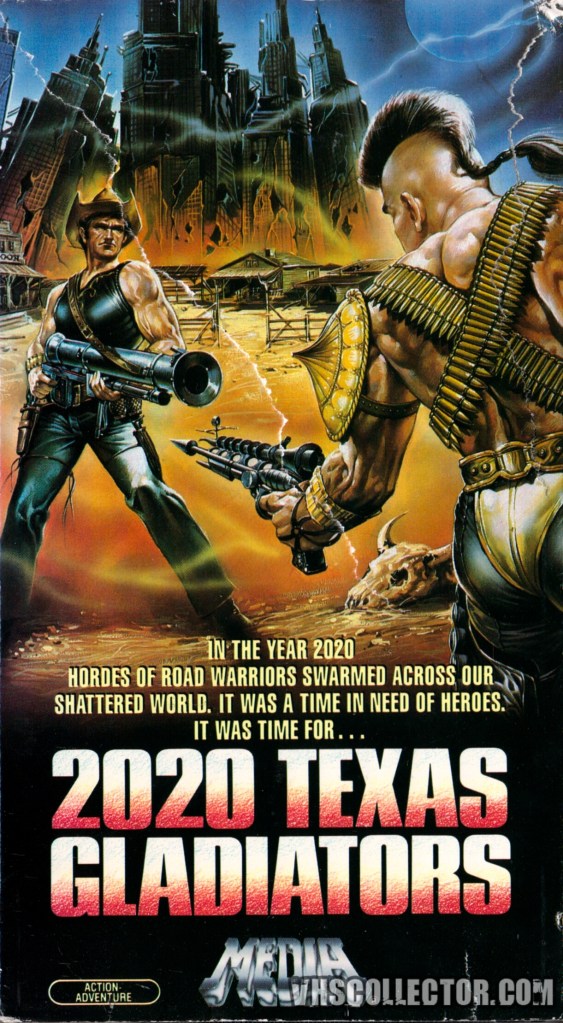
2020 FREEDOM FIGHTERS (“2020 Texas Gladiators,” Italy, late 1982). This is the first of two imitators from exploitationer extraordinaire Joe D’Amato.
It’s a rare exception (maybe the only exception) to the “tragic loner hero” category, since it’s a band of good guys (five of them) rather than a single good guy even at the start. Some are killed along the way, but we’re still left with more than one good guy by the end.
With D’Amato at the helm, you won’t be surprised at finding multiple rapes, cut throats, sleazy gore, even a crucifixion. It’s probably the most exploitative of all imitators, rivaled only by Wheels of Fire.
Most vehicles are dirt bikes, but there’s an armored truck and a shark car in one scene. The music is especially good during the (many) action scenes. Actually the whole thing is pretty good as long as you’re in the mood for sleaze.
Trivia: it was co-written and co-directed by D’Amato’s longtime partner George Eastman. Both guys are Italian, using English pseudonyms.
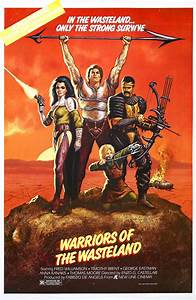
WARRIORS OF THE WASTELAND (“The New Barbarians,” Italy/USA, mid 1983). This one boils it down to the essentials, so much so that we never feel we’ve moved more than a mile from the original locations in the first scenes.
It’s basically one black-clad loner hero and his one friend fighting a small gang of evil gay long-haired rapist thugs.
The dessert setting is simple. The vehicles are small but fast, like dune buggies. Action comes often. It’s about average all around for a Road Warrior imitator.
Enzo Castellari also directed the great 1990: The Bronx Warriors (1982) which is more of an Escape from New York imitator. Both Bronx Warriors and Warriors of the Wasteland feature the flamboyant Fred Williamson (Black Caesar) in a prominent role.
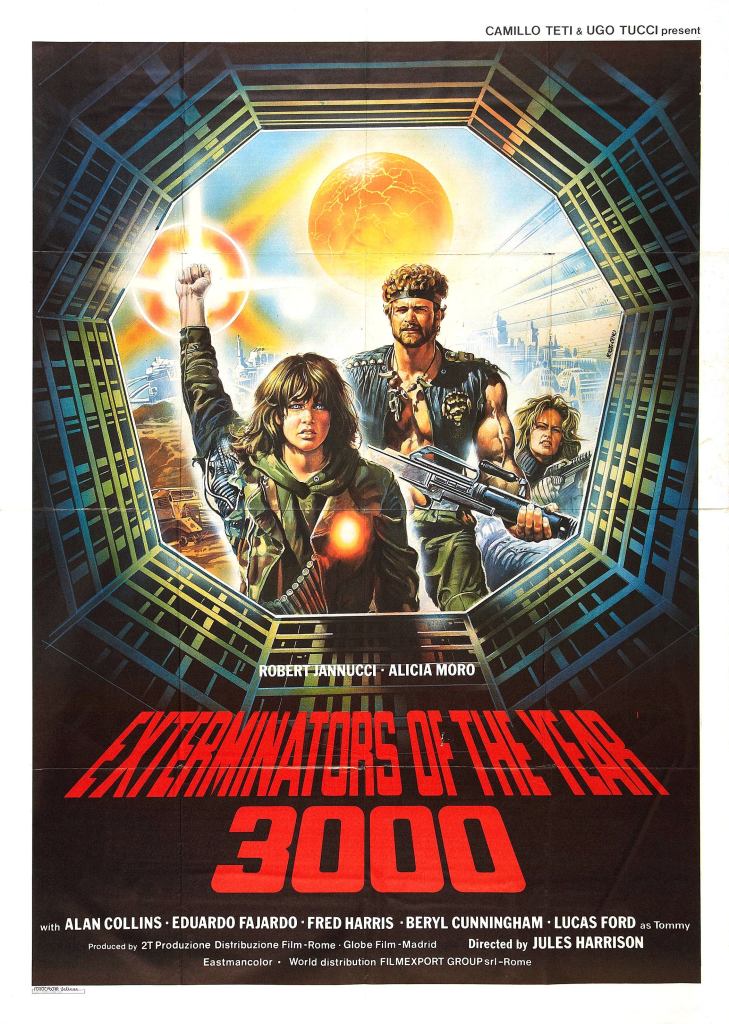
EXTERMINATORS OF THE YEAR 3000 (Italy/Spain, August 1983). “Exterminators” refers to vehicles, not people, and appropriately the movie has some of the best vehicle action in the subgenre.
Get yourself past the derivative plot, the simplistic dialogue, the routine score, the cheap film stock, the dull locations, the poor acting, the out-of-sync dubbing, and everything else, and then get into the road action.
I usually dislike slow motion, but I sure liked it here during the vehicle crashes. You can watch windshields shatter. The hero’s “Exterminator” has cages around the fenders to protect the tires, plus spikes, side armor, and a bulletproof slat shield.
The loner hero befriends an adolescent boy, so the movie is almost family friendly.
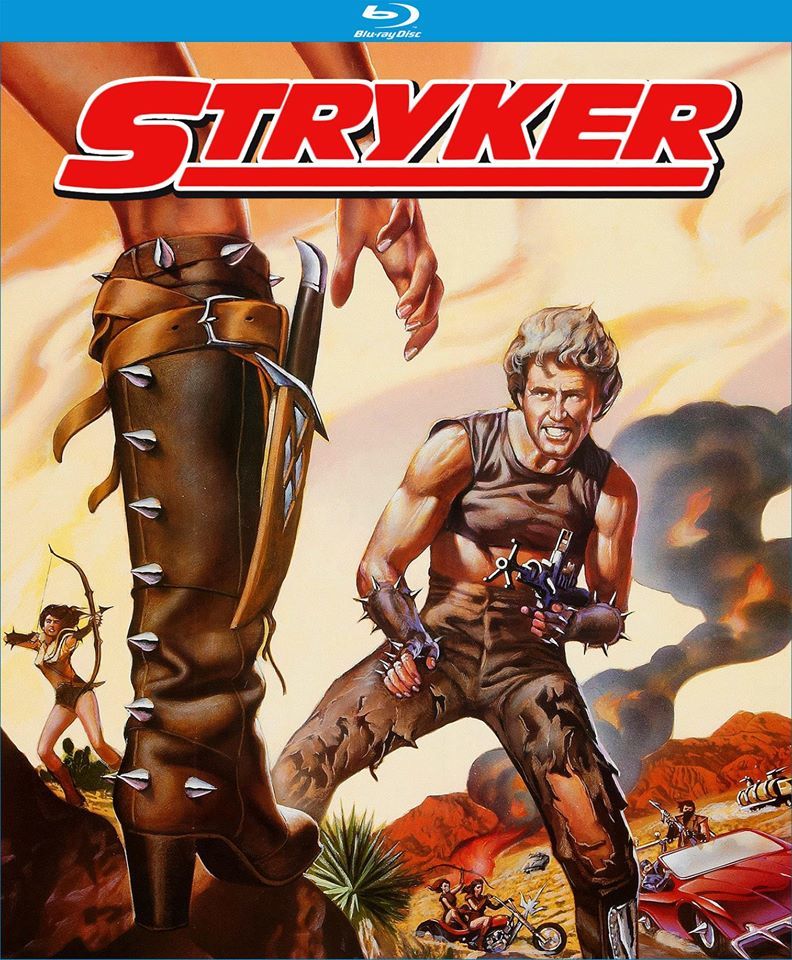
STRYKER (Philippines, Sept 1983). Cirio H. Santiago directed a total of six (!) Road Warrior imitators through 1992. This was the first.
Action scenes – mostly shootouts – come so often that you can’t always tell who’s attacking whom or why. But Santiago is an action specialist, so the scenes are well staged.
The total vehicles are just a few jeeps, a tanker truck, a couple of motorbikes, one muscle car, and two small tanks. The small tanks, borrowed from the Philippine army we presume, are the most memorable.
Some brief gore comes early, and a rape with brief nudity comes around halfway, yet it’s more like an action-adventure film, not an exploitation film like Santiago’s Wheels of Fire (see below).
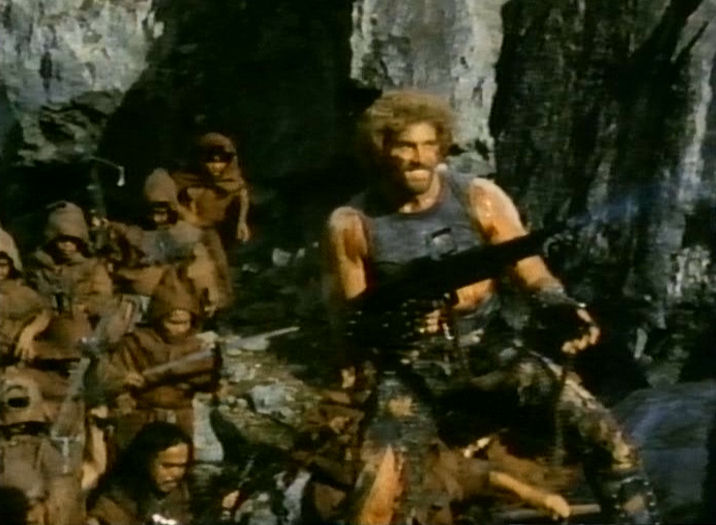
Steve Sandor played a lot of supporting tough-guy roles over the years. He wears a cowboy hat for almost the whole of Stryker, and he really does use a machine gun one-handed (in a late scene) like in the promo posters.
Though a Philippine production, it was co-written by Roger Corman collaborator Howard R. Cohen and distributed by Corman’s New World Pictures.
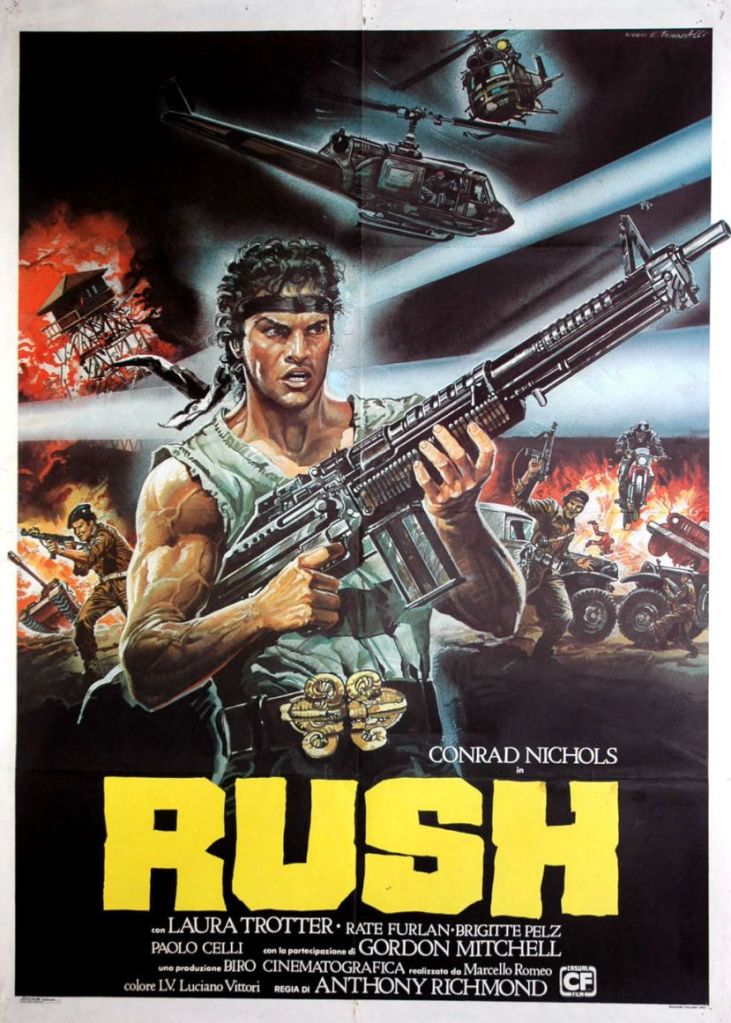
RUSH (Italy, Oct 1983). Here’s an idea: combine Road Warrior with First Blood! (First Blood was an even bigger hit than The Road Warrior, enjoying three weeks at number one in late 1982).
Thus, the hero (named “Rush”) looks obviously like Rambo with his hair, tank top, and headband. But they stuck him into a post-nuke wasteland.
The second half is more obviously the First Blood half, where our hero hides in the woods, uses trickery to outwit the soldiers chasing him, and single-handedly takes down the evil army with machine guns and grenades.
It’s handicapped by a low budget and a slow pace, but the preponderance of action in the second half and the screen presence of singer-actor-model Bruno Minniti go a long way toward making this Italian production likeable.
Vehicles are mostly regular jeeps, but a half track rolls for about a minute toward the end.
The same director and star made Rage a year later.
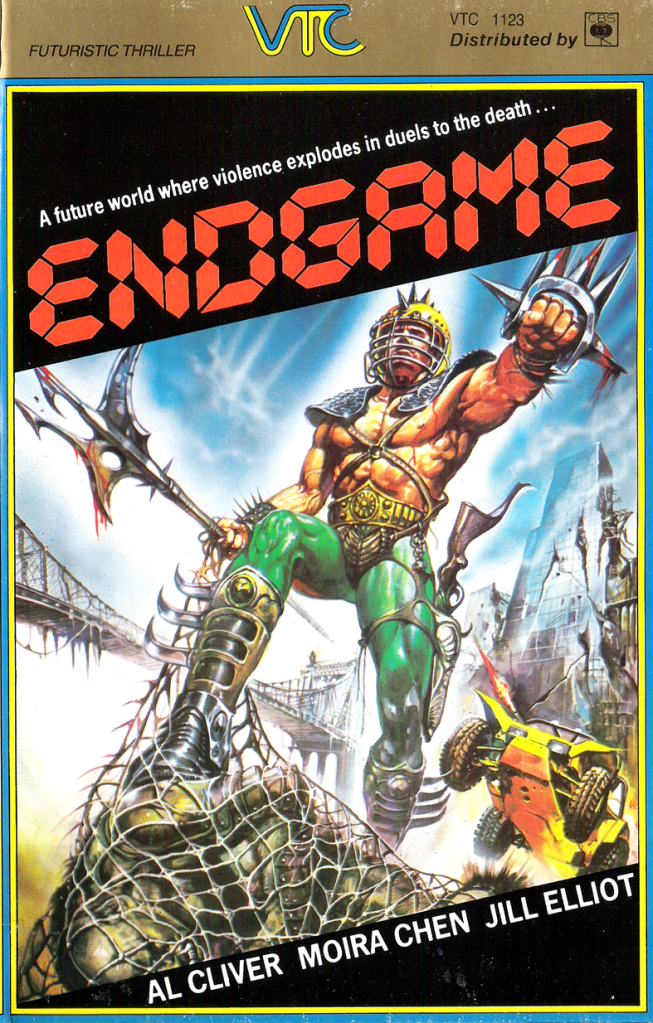
ENDGAME – BRONX LOTTA FINALE (Italy, Nov 1983). Here’s Joe D’Amato again. Endgame is a rare exception to the “one name” category so common in Road Warrior imitators. Here, everyone has a regular first and last name. Society hasn’t totally broken down in this one, at least not in the city where the movie opens.
In the second half, once we leave the city, it’s a familiar Road Warrior wasteland with random gangs on motorbikes or trucks set for an ambush. The cars and trucks don’t look like much, with minor cage armor, so it’s mostly motorbikes with stuntmen falling off, in the action.
An unwitting Hunger Games precursor, Endgame‘s plot revolves around a human hunt reality show. Eventually, the hero tries to escape the other hunters and help some telepaths cross the wasteland.
It’s a mishmash, actually, but with Joe D’Amato directing, you can’t go far wrong. Action is almost nonstop.
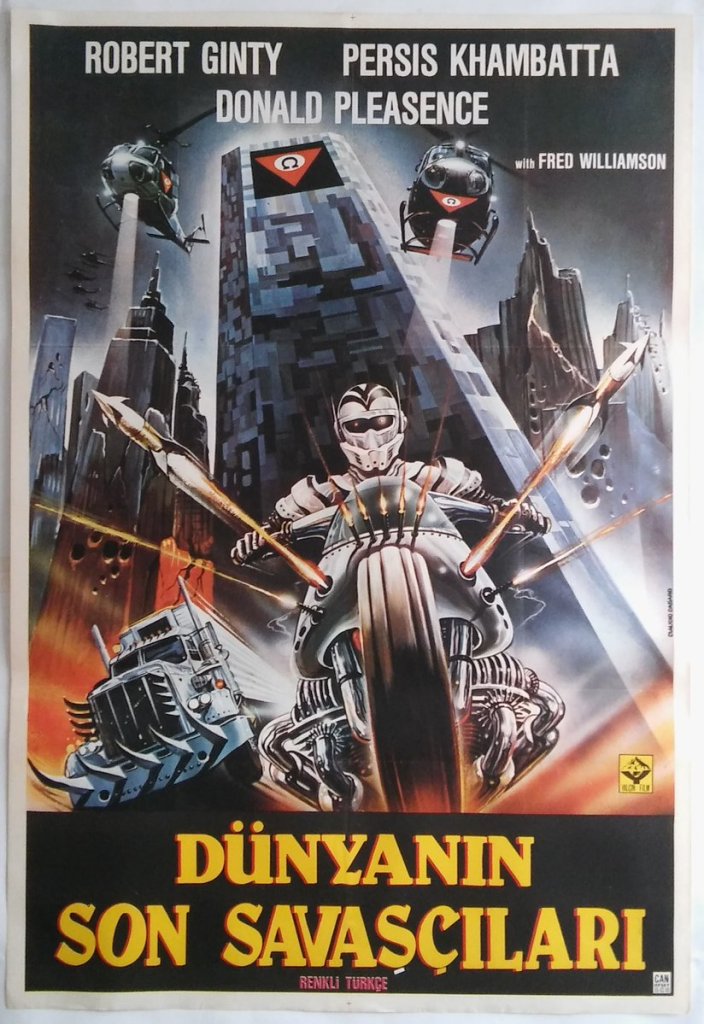
WARRIOR OF THE LOST WORLD (Italy/USA, late 1983). More science fictiony and more campy than the other films on our list, this very fun film gives our hero an intelligent sentient motorbike obviously inspired by KITT from Knight Rider. Both the hero and his bike crack sarcastic jokes as they aid innocent vagabonds against evil warlords.
Donald Pleasence, the most famous cast member, plays the evil cyborg warlord Prossor. He doesn’t have many lines, but he pulls a few surprises at the conclusion. Persis Khambatta (Ilia from Star Trek: The Motion Picture) co-stars as the heroine fighting alongside Robert Ginty (The Exterminator).

My favorite thing about Lost World was how everything was named and labeled. I assume this was intended to be funny.
We enter a Dark Age of Tyranny. The warlord heads The Omega. Outside the warlord’s control is The Wasteland. Some enlightened elderly people are called The Enlightened Elders. A secret illusionary wall is The Secret Wall of Illusion. A brainwash machine controller is actually labeled the “Anti Mind 114,” apparently just the latest in a long line of brainwash equipment.
Many of you will choose the MST3K version, but the full original version is very exciting and fun.
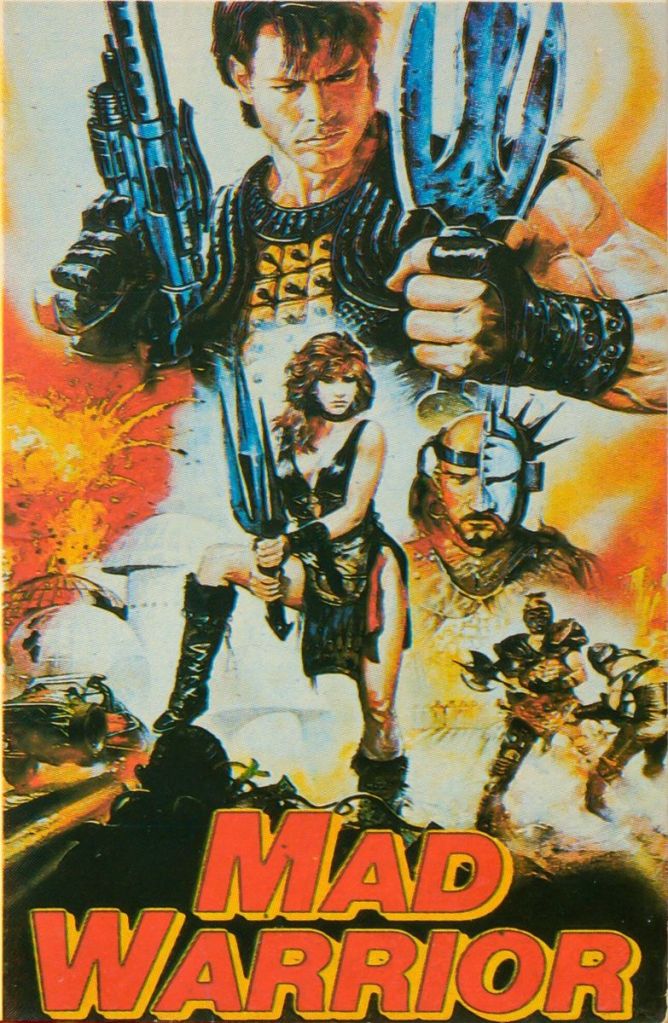
MAD WARRIOR (“Clash of the Warlords,” Philippines, Jan 1984). Probably the most low-budget of all Road Warrior imitators. Could also be the worst of them all, yet it’s still very entertaining.
It’s mostly gladiator bouts and tribal warfare, and – unlike all other imitators – it sets itself on an island.
To make sure you know the protagonist is “mad,” characters say things like “He’s really crazy, he’s completely nuts!” and “He’s not just crazy, he’s a lunatic!” The hero’s name is Rex, so I guess he’s Mad Rex.
Actually the whole picture is nutty, often unconsciously. Everyone jumps around with drunken energy. The final duel even has light sabers!
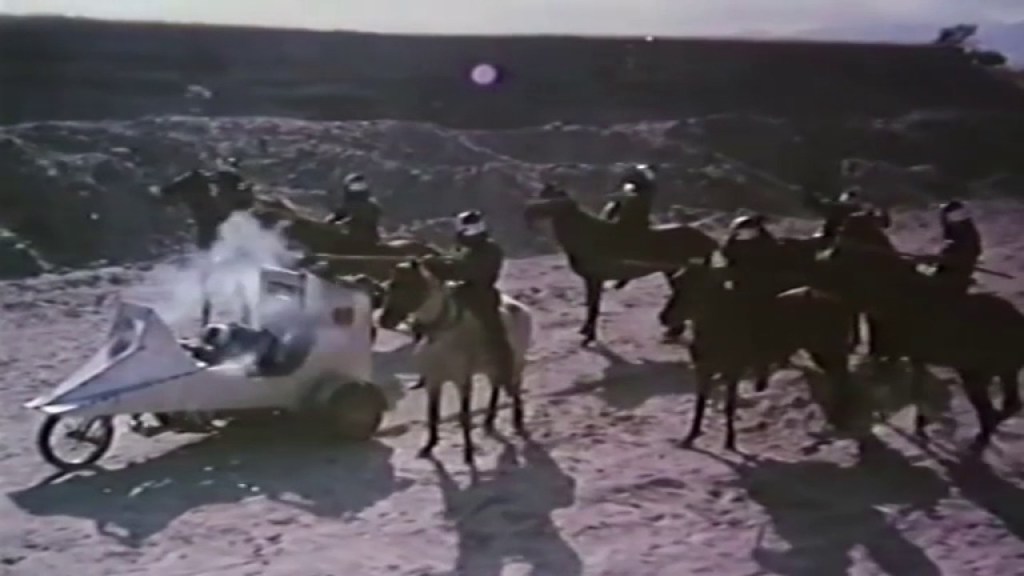
So once again, it’s just fun to watch – as long as you want to watch random tough guys in punk leather outfits duking it out in a scraggly wasteland.
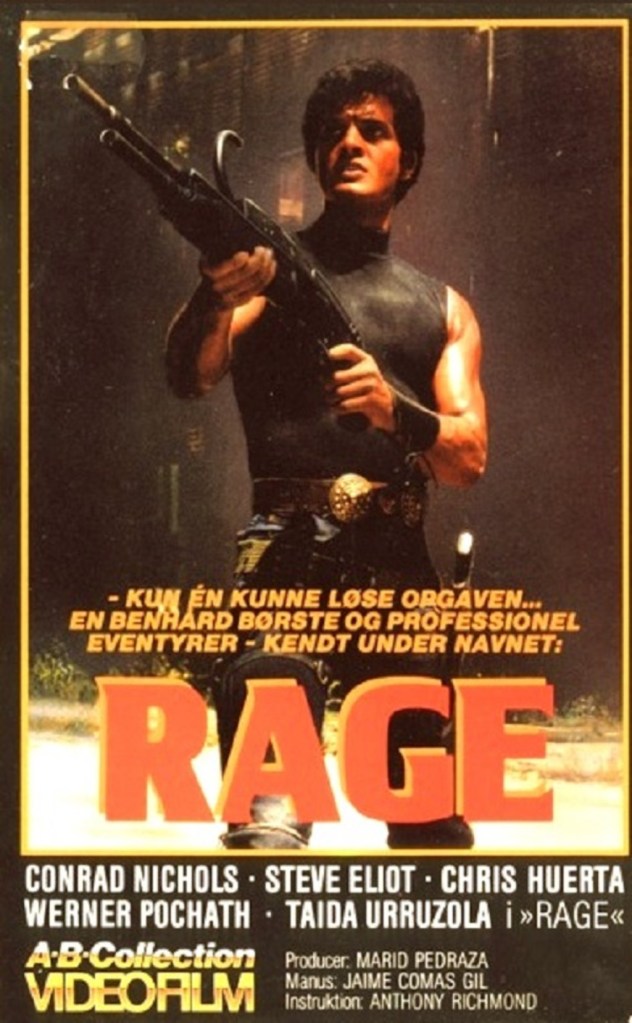
RAGE (“A Man Called Rage,” Italy/Spain, late 1984). This one has the same director and star as Rush (see above). Either this or Mad Warrior is probably the worst of all imitators on our list.
But several action scenes are good, and, weirdly, this film tries to be uplifting and moral – totally different from the exploitative sleaze so prevalent across the subgenre.
It’s unique in that the good guys and bad guys make peace at the end. It’s also unique in featuring a train (not a truck, car, or motorbike) during the fight at the climax.
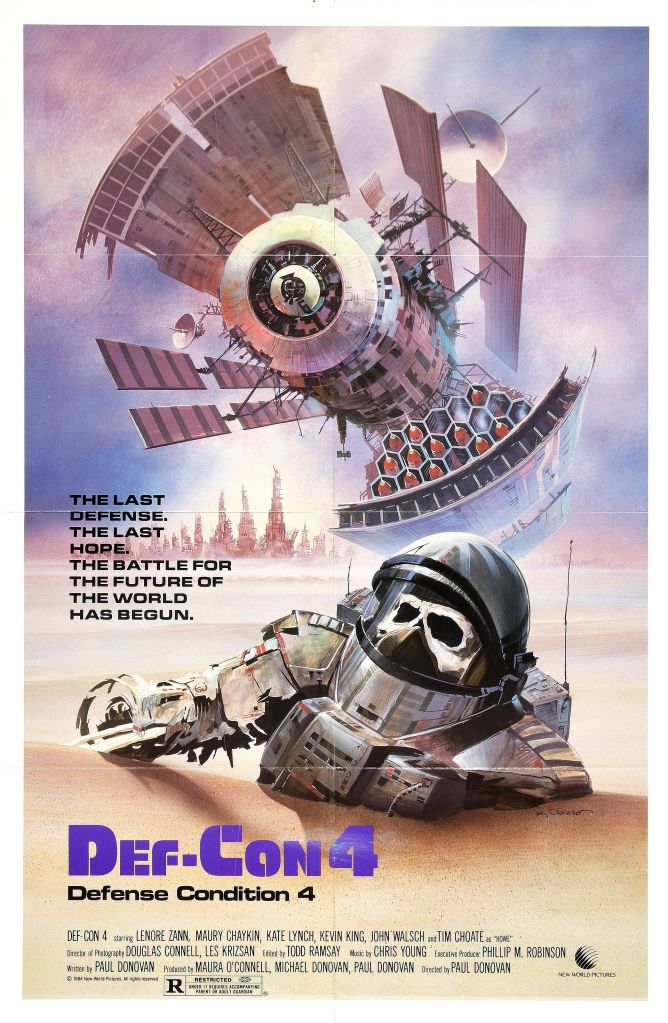
DEFCON-4 (Canada, March 1985). With Warriors of the Apocalypse, this is one of the few disappointing movies on the list. For starters, it should have been “Defcon-1.”
In the simple story, astronauts in orbit are spared the fires of nuclear war… but when they return to Earth they find a savage wasteland.
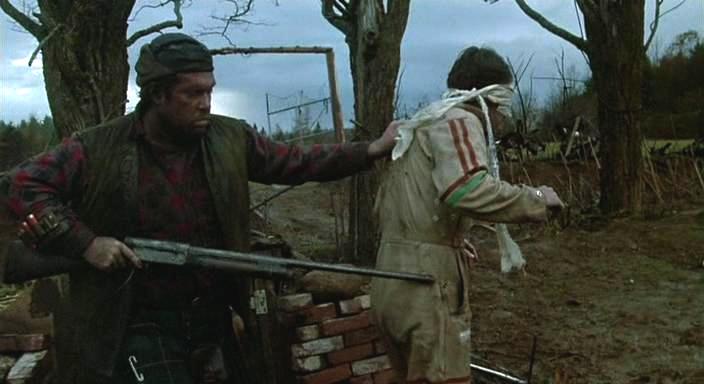
The extended opening segment – inside a space capsule before we get to the Road Warrior stuff – is the highlight. Then it all goes downhill, bitter and pessimistic in its atmosphere yet generally light on action. It wants to be exploitative but it feels too sad.
From a Road Warrior fan’s perspective, the vehicle highlight is an armored loader fitted with a red drill.
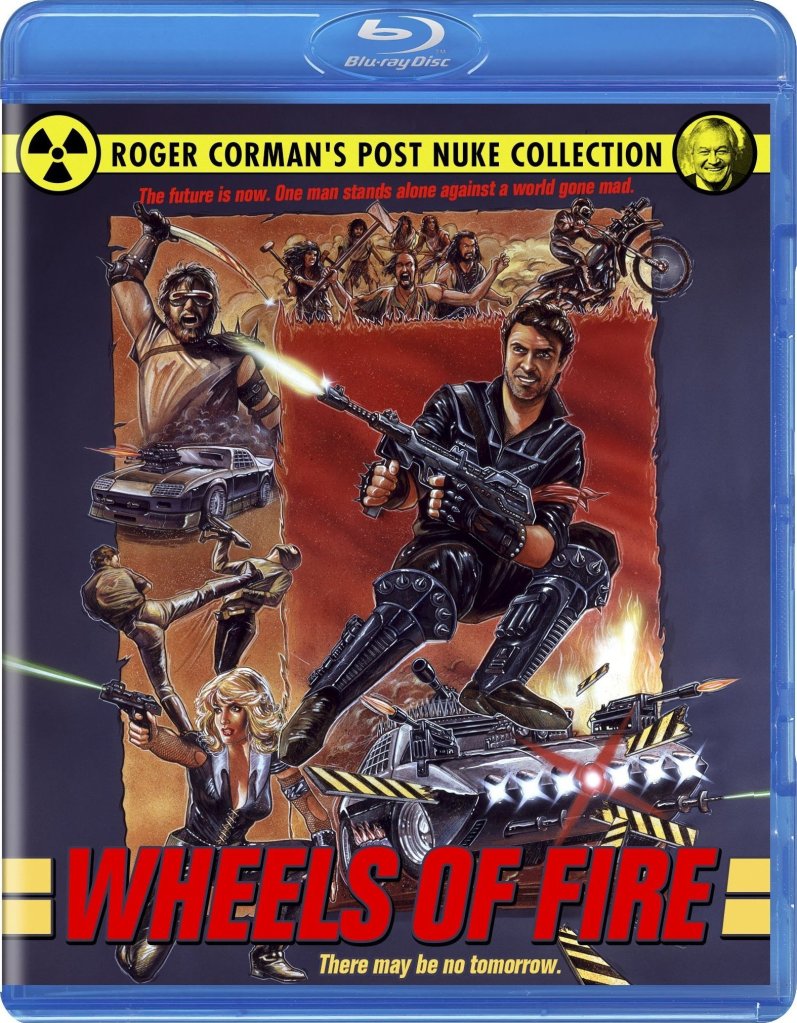
WHEELS OF FIRE (USA/Philippines, Sept 1985). You can almost hear the filmmakers thinking aloud as they planned this one… “hm, we’ve already done a lot of car, truck, and motorbike battles in these types of movies, so is there anything else we can do? Anything else that our target demographic of 18-22-year-old males will enjoy? Why, of course! Boobs!”
And so the big-boobed blonde anti-heroine (our black-clad hero’s dissolute sister) is captured and topless for the whole second half.
So if you can accept the rampant sexism, you have to award points for sheer audacity. They’re trying pretty hard to entertain the target audience.
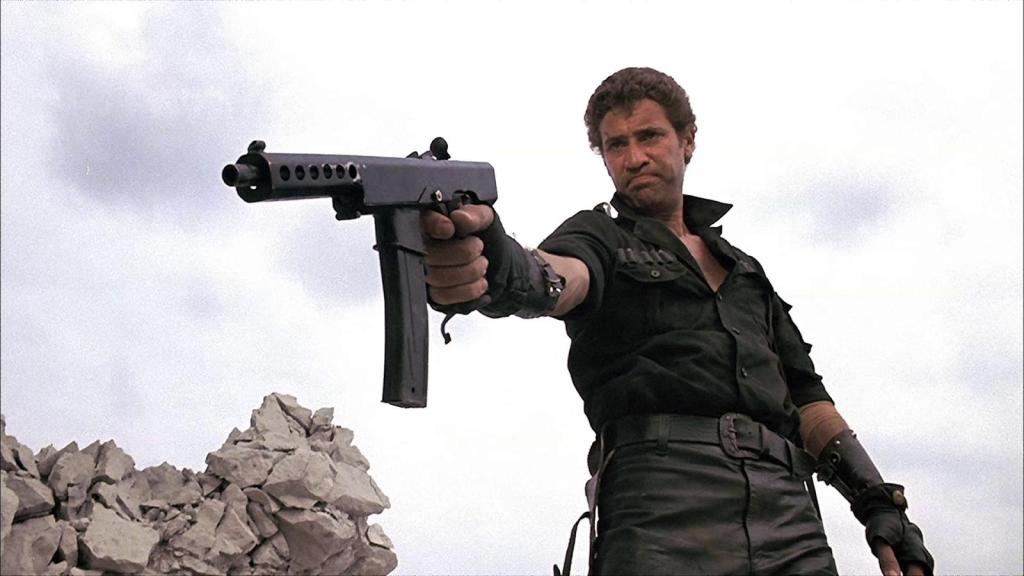
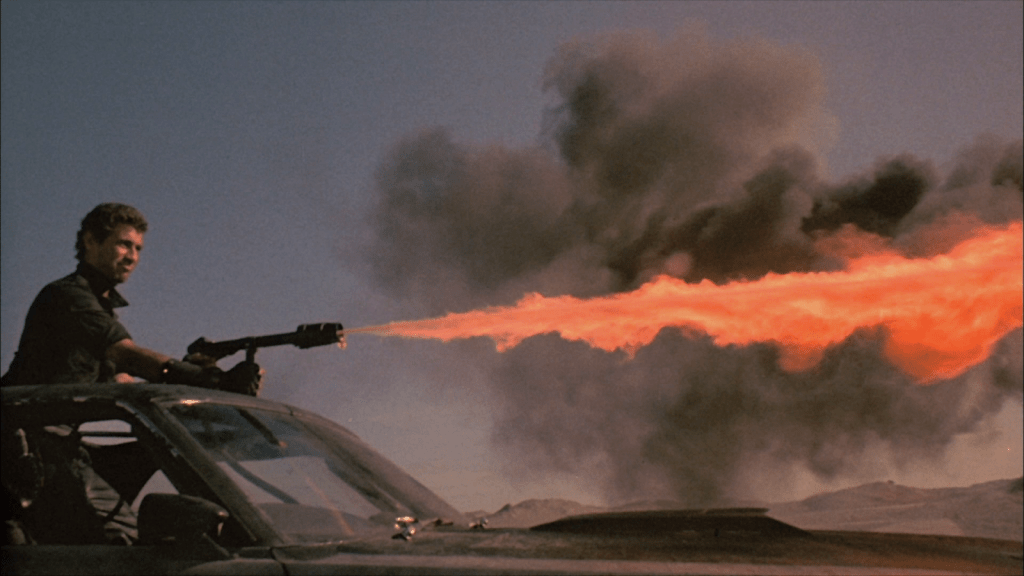
The preponderance of gun battles, grenades, flamethrowers, and exploding cars suggests that Wheels of Fire had an unusually high budget for this kind of film. On the IMDb, it’s one of the highest rated of all imitators.
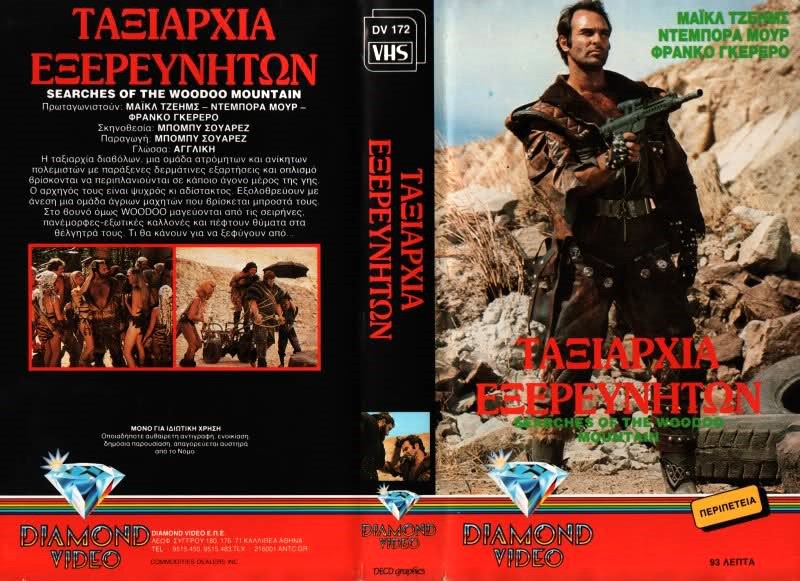
WARRIORS OF THE APOCALYPSE (“Searchers of the Voodoo Mountain,” USA/Philippines, Dec 1985). This could be more of a Raiders of the Lost Ark imitator as the alternate title implies, though it’s a Road Warrior imitator for the first 10 minutes.
The black-clad leader eventually leads his little gang from a wasteland into a jungle, but action is scanty and pacing is draggy. The lead actor looks like Burt Reynolds, but his acting is stiff as a hat rack.
Luckily, there’s plenty of nonsense to laugh at.
An evil clown-faced pygmy jumps down at the good guys in slow motion. Imprisoned beneath a voodoo sacrifice temple, betrayed by a guide, stripped of weapons and equipment, the brilliant Doc remarks “This place is evil! I can feel it!” The hero shows his bare butt in an implied sex scene. At the end, the evil princess uses her throne to shoot grenades! And laser beams!
Historically it’s interesting in that the hero doesn’t leave at the end; he actually sticks around to aid the nascent society he helped to free from the bad guys.
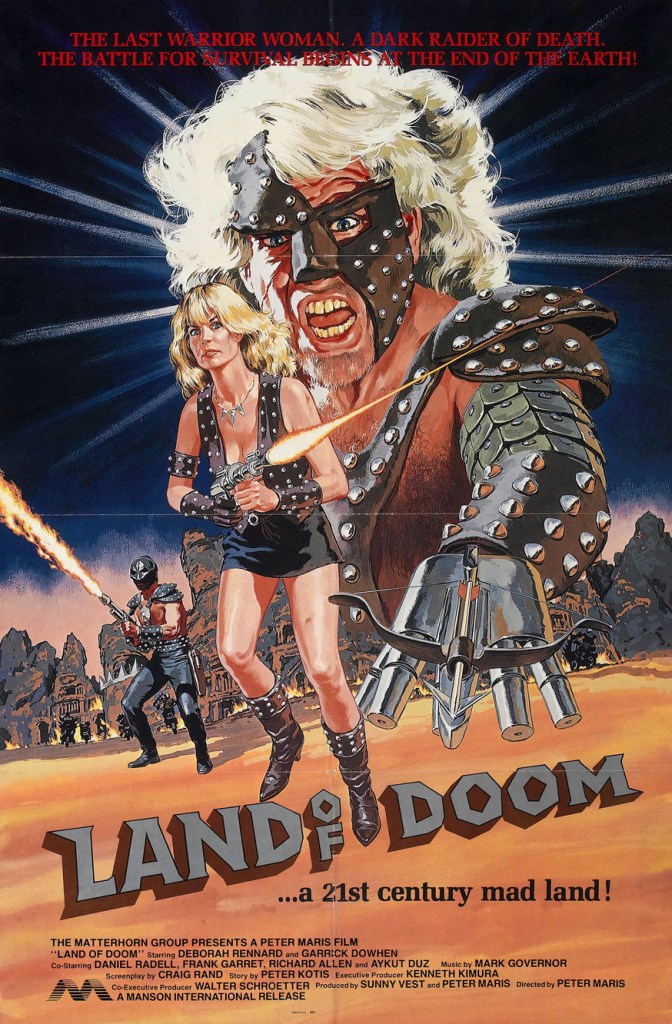
LAND OF DOOM (USA/Turkey, 1986). Here’s the first Road Warrior imitator to feature a heroine, probably from Beyond Thunderdome influence.
Sadly, the heroine is annoying. She’s touchy and rash, she meets a nice guy who helps lighten her up, but the actress (Deborah Rennard from Van Damme’s Lionheart) can’t project any emotion or motivation underneath it all. Her name is “Harmony” although “Discord” might have been more fitting.
Luckily, good locations, good costumes, good music, and good motorbikes make Land of Doom quite enjoyable anyway.
I never tired of the Turkish locations (mostly the Fairy Chimney areas near Cappadocia), the studded leather straps and masks, and – best of all – a dozen motorbikes fitted with shields, pipes, spikes, and flanges.
These fittings evidently made the bikes hard to ride, since stunts are few and speeds are slow. But they really do look good.
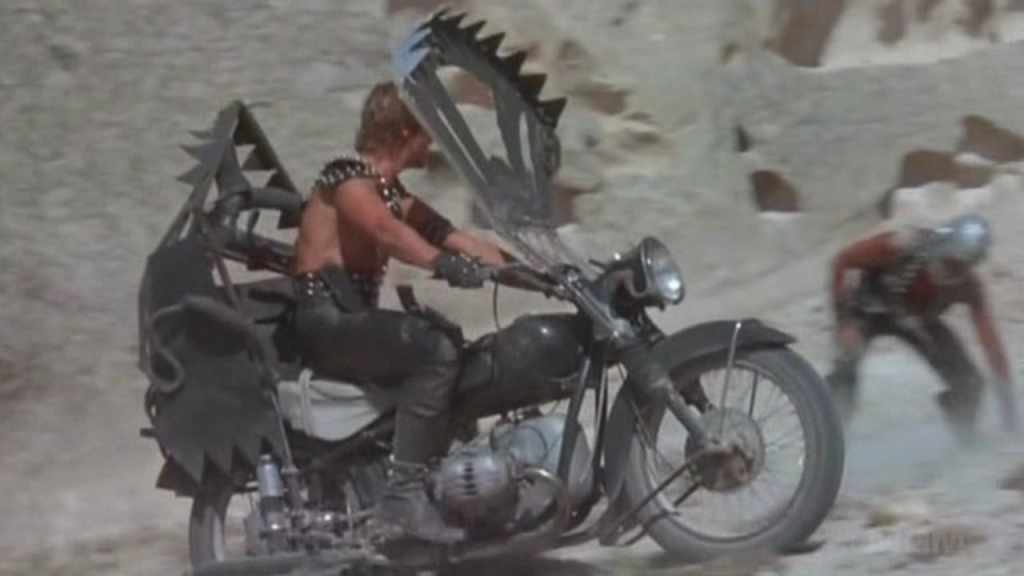
So for Road Warrior fans who like their vehicles, Land of Doom is worth the price of the annoying heroine, dull plot, and inconclusive ending.
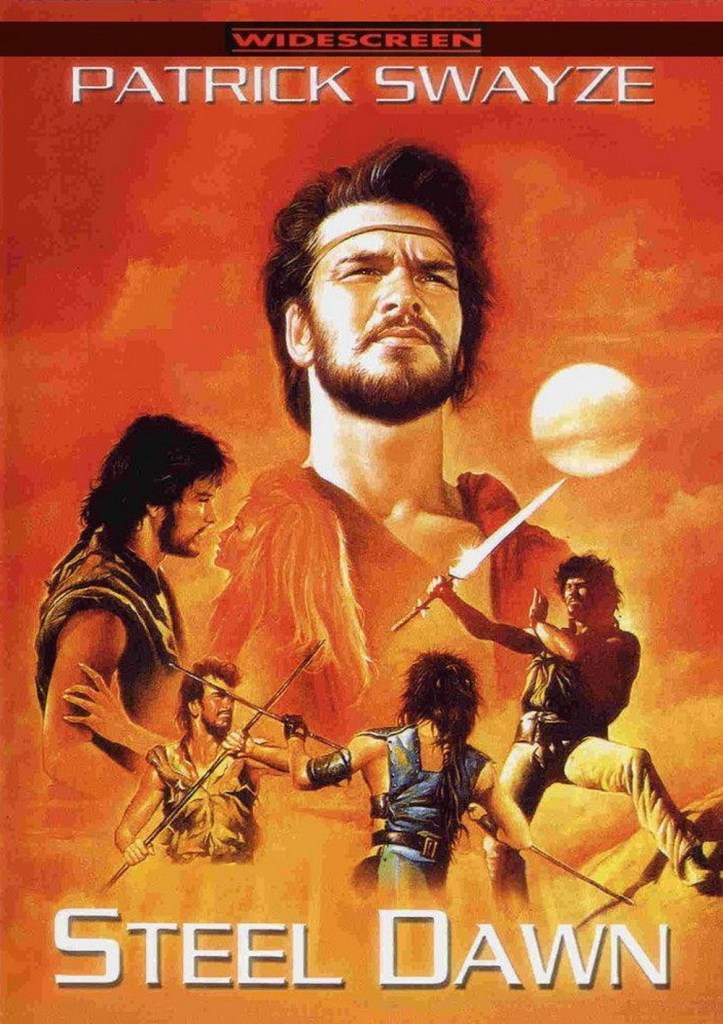
STEEL DAWN (USA, Nov 1987). Here is the first all-American Road Warrior imitator, and the first with high production values.
Though it feels over-produced, with a Hollywood sheen and a self-conscious avoidance of exploitation, it manages to develop several likeable characters, especially the hero played by Patrick Swayze, a rising star at the time.
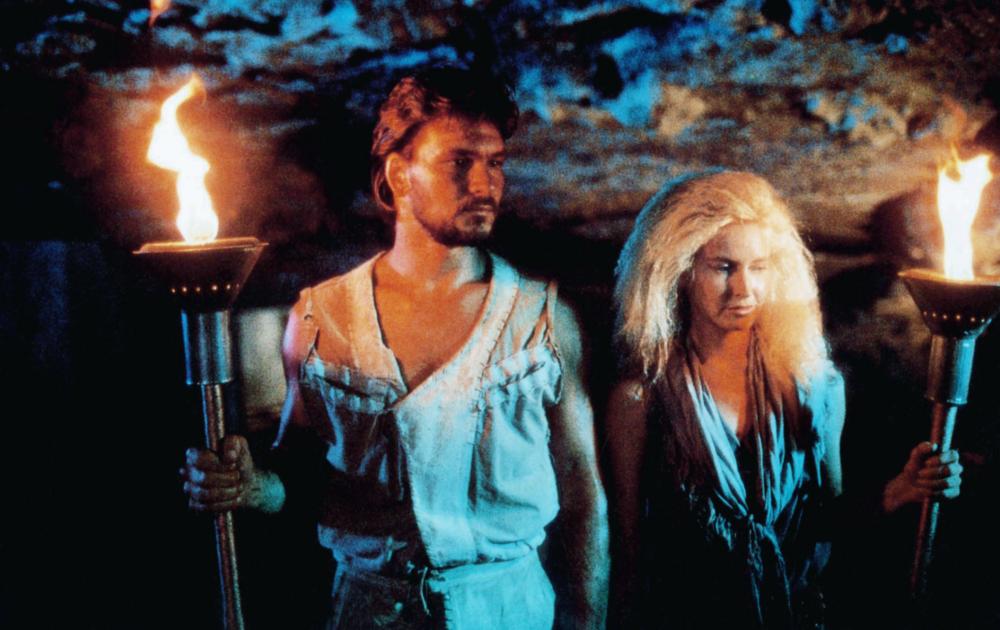
It’s nice that we spend so much time with the little farming community, struggling to create – rather than destroy – something in the wasteland for a change.
As is typical for Road Warrior imitators, everyone wears stylish leather or padded armor. Cars figure into an unusual chase toward the end, but it’s “wind racer” cars with sails rather than the usual armored fighting machines. Like several other imitators (Stryker most notably), the scarce resource is water.
Unlike in other imitators, a central government is hinted at (the “Council of the Order”), but still the story focuses on some very small groups of ragtag antagonists. The bad guy only has five or six thugs!
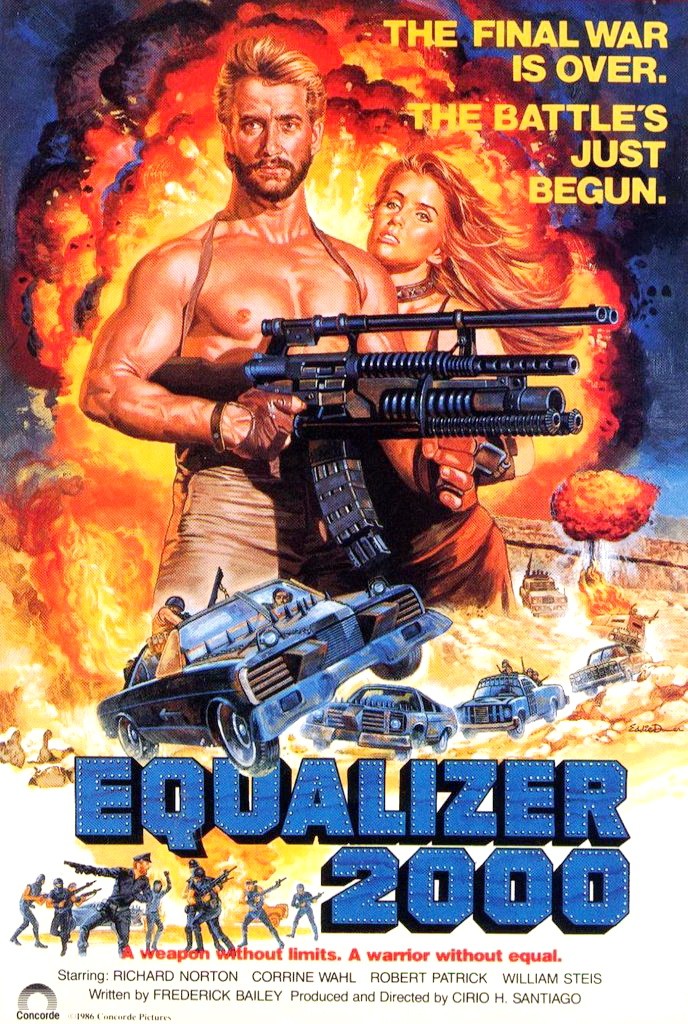
EQUALIZER 2000 (USA/Philippines, May 1987). The title refers to a sleek-looking weapon, a sort of machine gun and RPG combo with multiple barrels. I didn’t see why it was necessarily superior to the machine guns, mortars, or flame throwers that everyone already had. But the characters all treat the Equalizer like a Holy Grail.
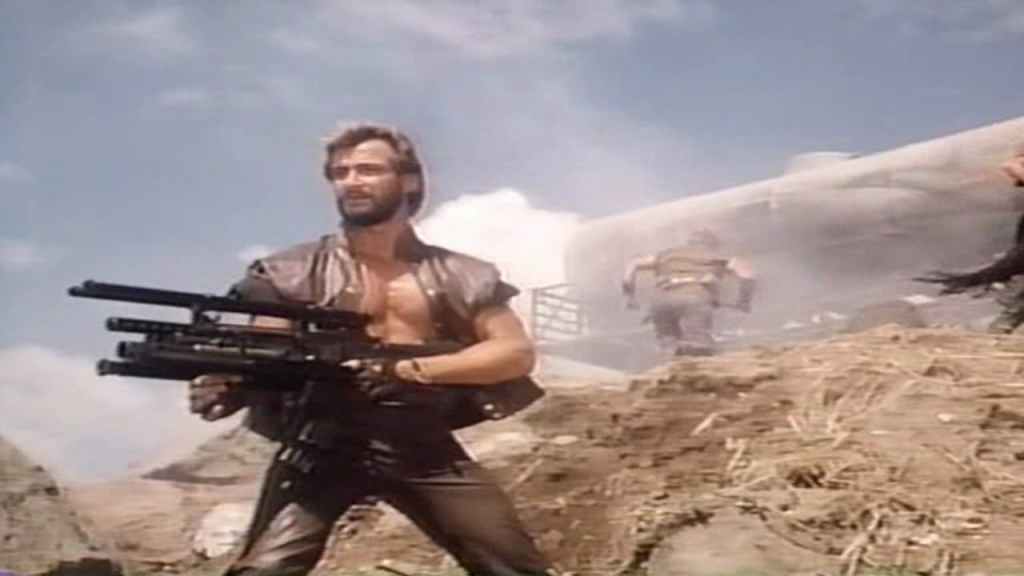
Luckily, the Equalizer and a lot of other weapons get used almost continuously. The whole movie is basically an excuse to depict ragtag gangs shoot at each other in a desert wasteland.
In the Road Warrior tradition, we get a few decked-out or chopped cars and trucks. But mostly it’s shootouts and explosions. For straight-up action, it’s one of the best imitators on our list.
Allying against the Nazi-like villains are several good gangs including some native Mountain People who throw spears and whoop like Indians.
Our bleary-eyed hero is played by Australian Richard Norton who later played the Prime Imperator (while shirtless at age 65) in Mad Max: Fury Road.
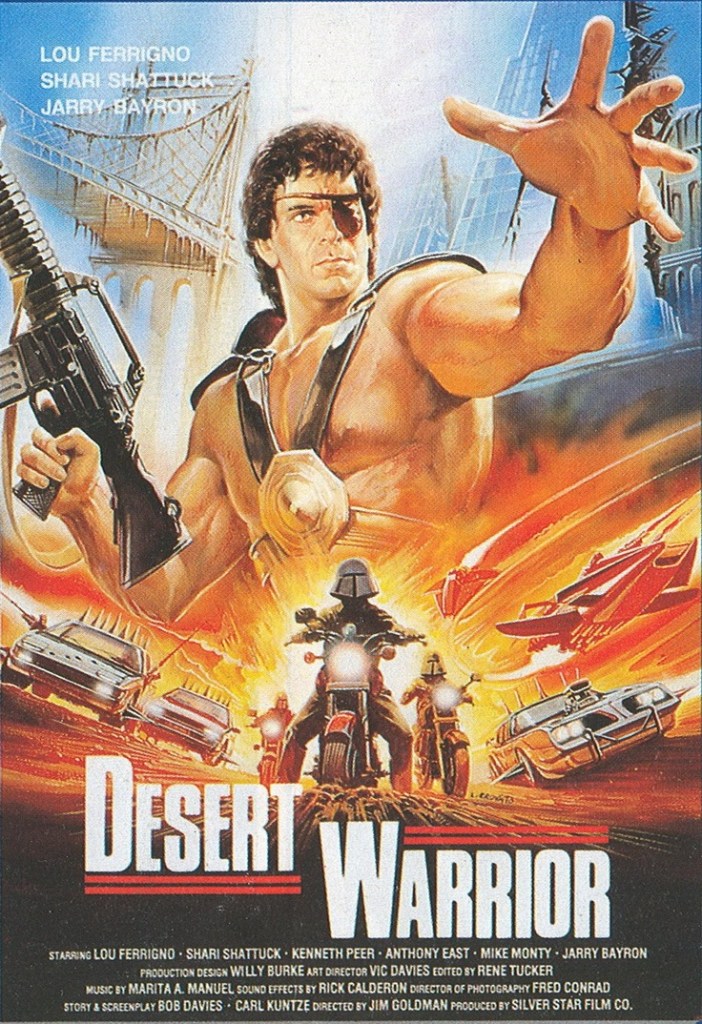
DESERT WARRIOR (USA, 1988). Here’s the silliest imitator on our list, one I’ve covered briefly before in my Forces of Geek article about silly Lou Ferrigno movies from the 80s.
Ferrigno is not as bad an actor as people pretend, but he’s certainly no Oscar winner, so if he’s the best actor in the movie, you know you’ve got Big Camp before we even get to the ridiculous plot, cheap props, or the astounding non sequitur ending.
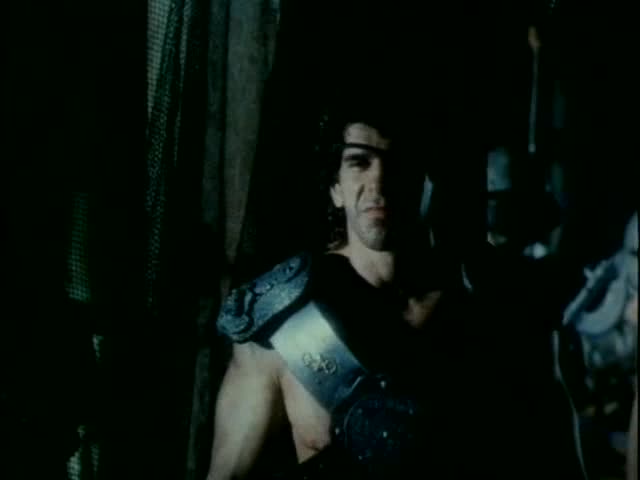
The main story pits roaming thugs against a base of good guys in a post-nuke desert. It’s more science fictiony than other imitators because of the space-age good guy labs and robots.
But the main appeals are two big battle sequences filled with bullets, laser beams, RPGs, and explosions. The filmmakers seem to have fought a battle themselves: a valiant fight to entertain the audience despite an obviously minuscule budget.
It’s cheap and ridiculous, with only a few armored vehicles, but at least you won’t be bored.
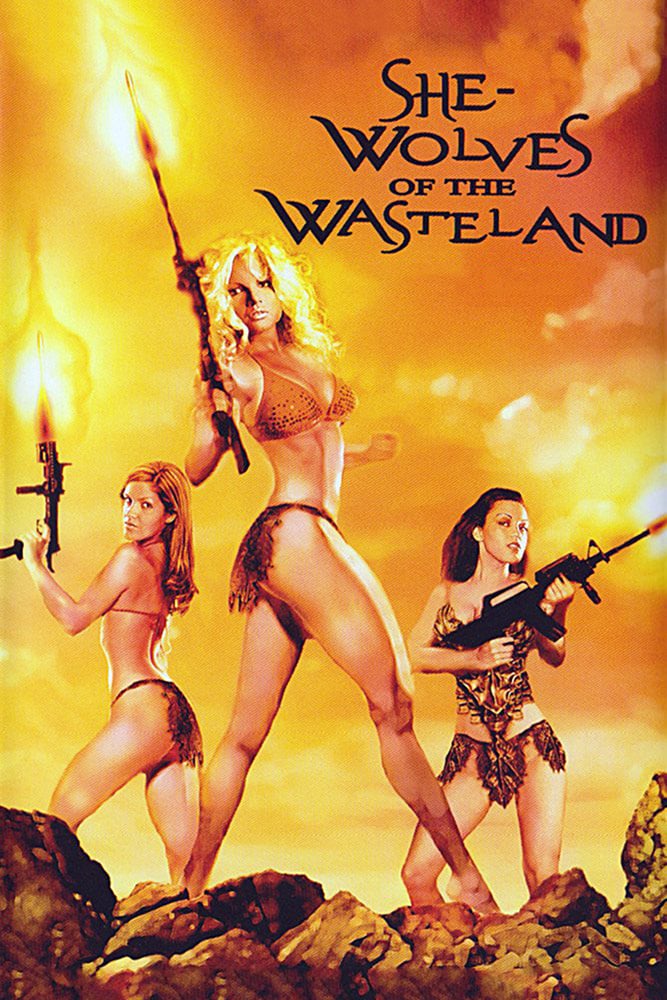
PHOENIX THE WARRIOR (“She-Wolves of the Wasteland,” USA, May 1988). This post-nuke exploitation flick has barely enough of everything – action, humor, nudity, gore – to sustain interest. But pacing is repetitive. Some viewers might give up halfway.
The main appeal is the display of full-figured females wearing skimpy outfits (a mix of leather, cloth, straps, rags, or robes) and brandishing guns and knives. Apparently all the ugly women died during the holocaust.
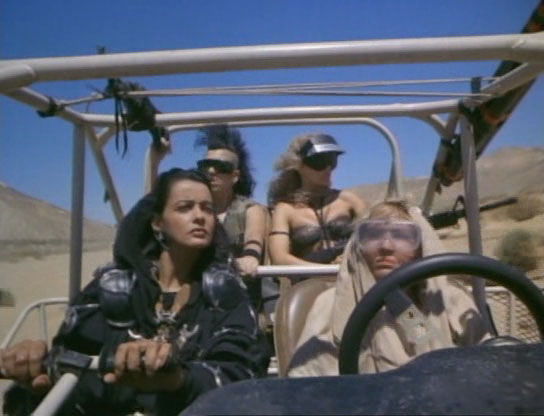
Actually one woman is ugly: the evil Revered Mother who wants to establish an empire by repopulating the world with her own bioengineered offspring. At least it’s somewhat original to feature an ugly boss instead of the usual “evil queen” or “dragon lady” types.
For most of the movie, our blonde heroine helps a young mother and her young child avoid the evil She Wolves across the “badlands.” They meet a man (perhaps the last one on Earth) who helps a few times. It’s like Hell Comes to Frogtown (its presumed inspiration) without the personality.
The main Road Warrior element is a dune buggy chase. My favorite thing was the continuous 80s instrumental rock score.
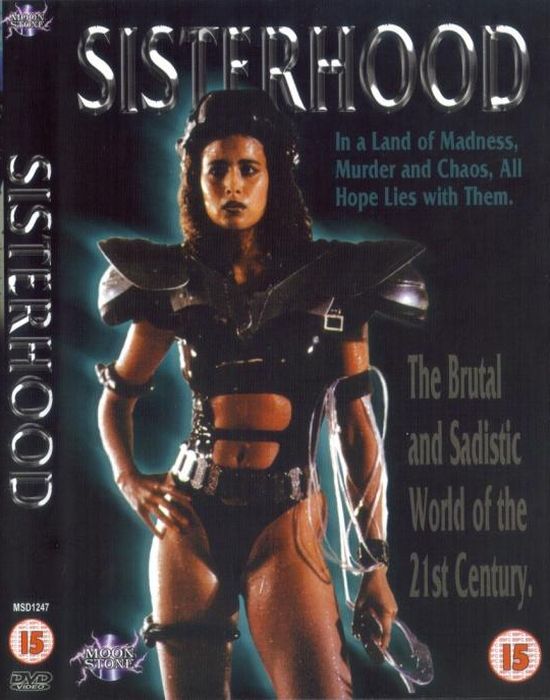
THE SISTERHOOD (USA/Philippines, Jan 1988). Unlike all the other imitators, there’s no real hero in this one. Instead, we get a heroine, since The Sisterhood is a unique feminist anomaly among the imitators.
Actually the heroine is pretty innocent and weak, but she meets some Amazon types who can shoot guns, drive trucks, swing swords, and even employ mental powers like telekinesis.
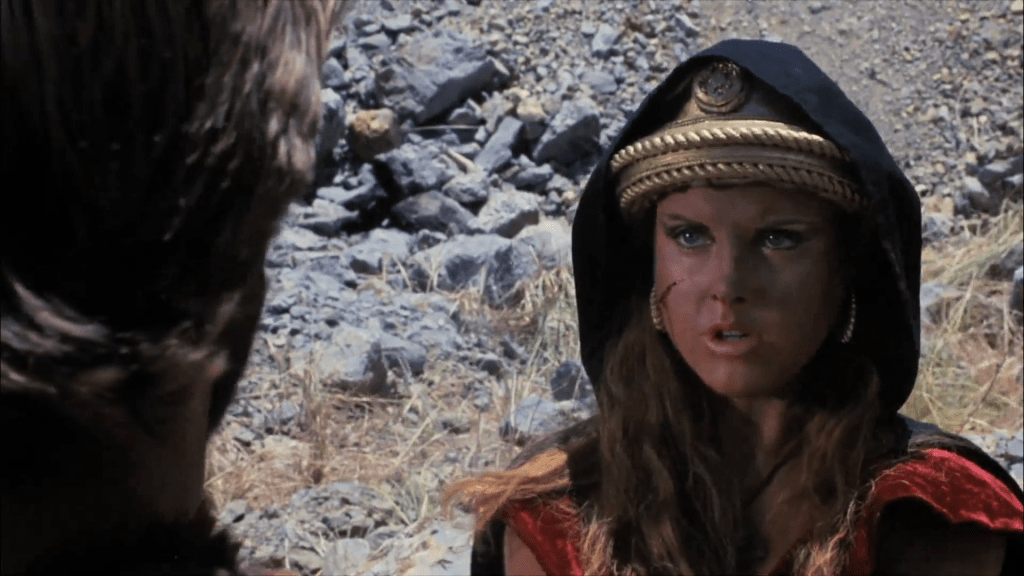
It’s surprisingly well-intended, but it’s just not exciting enough. The Sisters’ super powers rarely get used. The only good action scene – a swordfight – comes at the opening. Music is very cheap, like in an early-80s video game.
And you know that leather-clad brunette on the promo posters? Well, she’s not even in the movie!
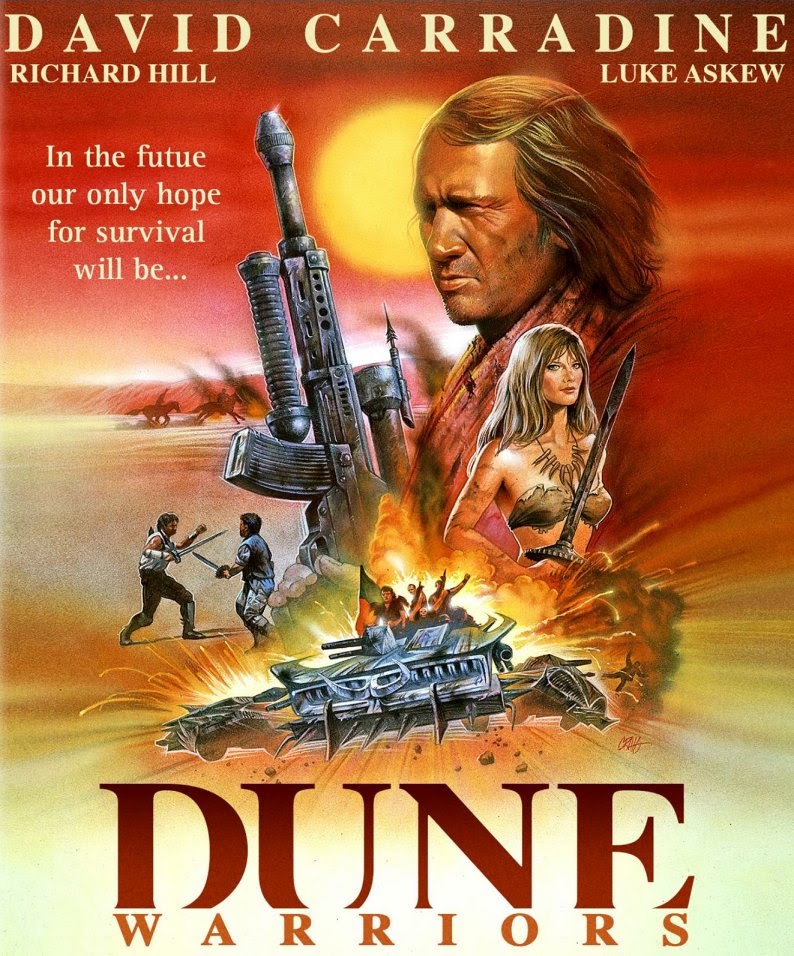
DUNE WARRIORS (USA, Jan 1991). I normally stop in the 80s, but I thought I’d add two obvious Road Warrior imitators from the early 90s. You’d think the subgenre would be spent by this point, but Dune Warriors actually has some of the highest production values of any imitator. Only Steel Dawn is more polished.
David Carradine stars as the older leader of the mercenaries hired to save an encampment of good people from a band of wandering marauders. It’s a Seven Samurai type story.
But though the plot is familiar, the characters are given honest motivations and distinct personalities. It’s not just a parade of shootouts and explosions.
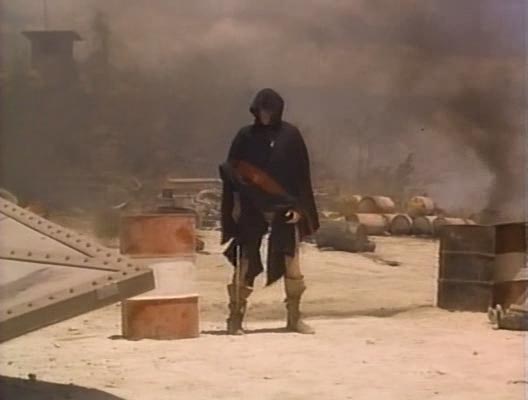
Action comes often, but conversations and interludes between the battles make the movie well rounded. The action itself is also well rounded, with a little of everything: gun battles, sword fights, duels (probably from Beyond Thunderdome influence at this point), artillery, car crashes, even quarterstaffs. Some of the hand-to-hand punch-kick-sword choreography is very good.
Unlike nearly all other Road Warrior imitators, Dune Warrior actually suggests a theme. It’s vaguely religious. Note the church cross in several shots when Carradine appears. He’s no Jesus… but perhaps he’s an avenging angel?
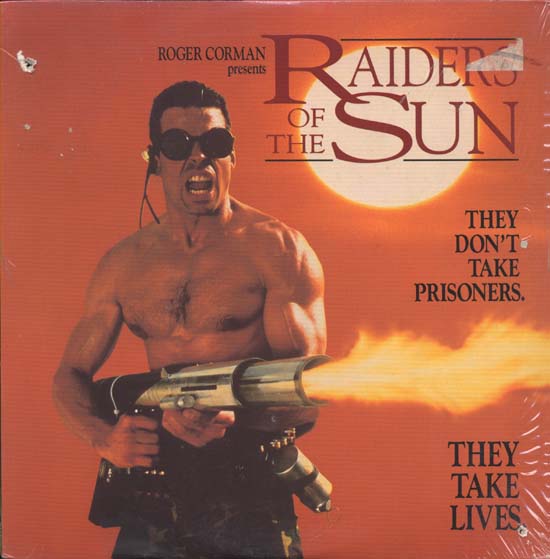
RAIDERS OF THE SUN (USA, July 1992). This is not only the sixth and final Road Warrior imitator from Cirio H. Santiago, it’s also the final film from the Golden Age of Road Warrior imitator films.
It recycles footage from Wheels of Fire and Equalizer 2000, but it also knows its place, never pretending to be anything more than a pile of cheap thrills for an 18-22-year-old male target audience.
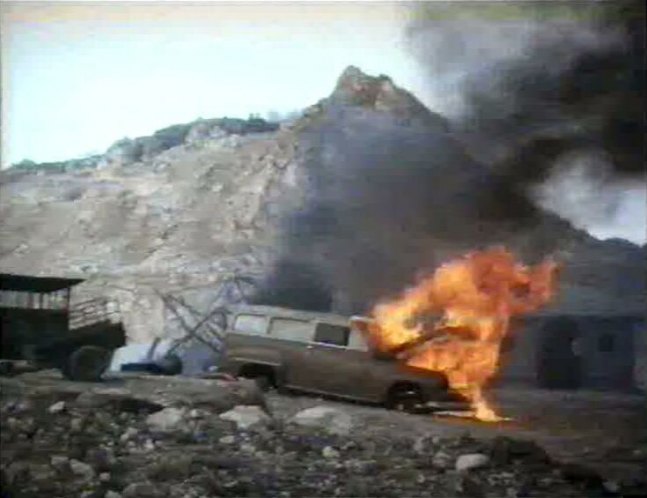
The plot is somewhat original, featuring two heroes and two villains who mostly fight separately until the conclusion.
Most of the action is from gun battles, but there are road battles too. It’s a pretty satisfying way to say farewell to a pretty satisfying subgenre.

Article text copyright (c) 2025 David E. Goldweber
Originally posted May-Oct 2018 on Forces of Geek
 Claws & Saucers
Leave a comment