
“HOWLING” THROUGH THE 80s
Have you read my rundown of “1980s Werewolf Movies” in Scary Monsters #131 (Summer 2023)? Werewolf movies, like their close companions Jekyll/Hyde movies, tend to be a high quality bunch.
Here, I post my review of the original The Howling, excerpted from the Claws & Saucers guidebook. Below it, I add a bonus review of the remaining Howling movies of the 80s, a combo review of Howlings II-V.
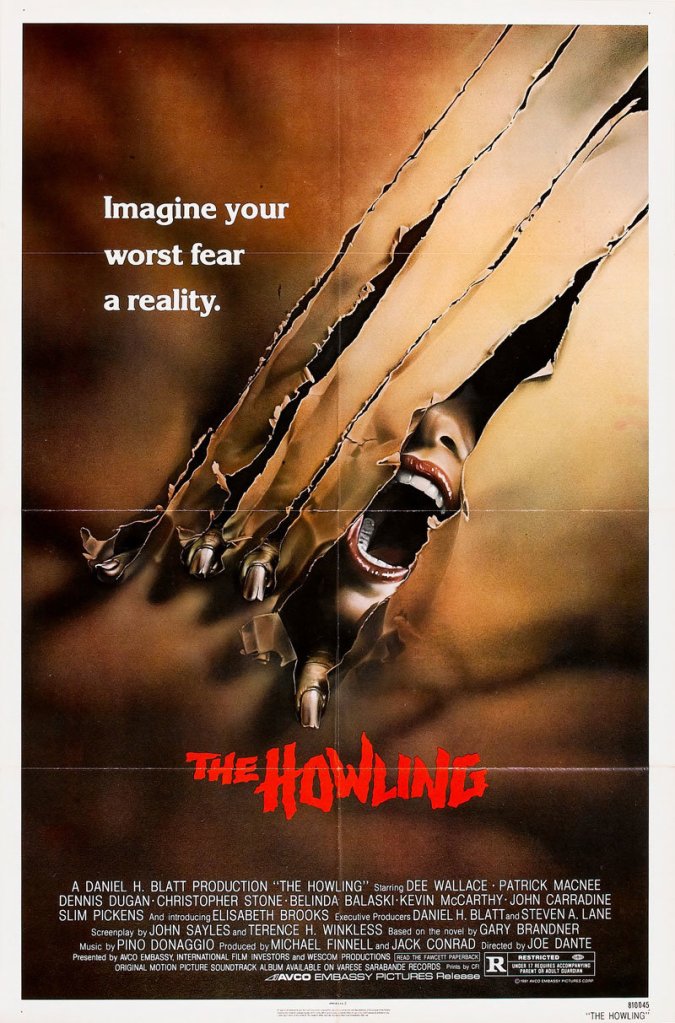
THE HOWLING (Joe Dante, 91 min, color, 1981)
What’s Happening: Residents at psychiatric retreat are attacked by werewolves
Famous For: Stunning werewolf transformation sequences
With so many self-conscious genre references and in-jokes, The Howling feels years ahead of its time. Like Wes Craven’s Scream movies, it knows the conventions and plays with them. It is as much a satire or send-up of werewolf movies as it is such a movie itself. It’s one of the first horror movies of this type.
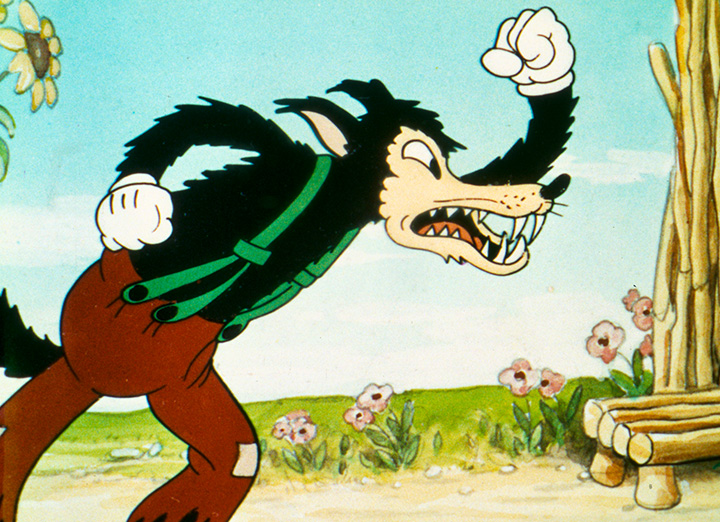
The famous jokes and references include characters named George Waggner (who directed the first Wolf Man) and Jack Molina (a.k.a. Jacinto Molina, Paul Naschy, of Frankenstein’s Bloody Terror), two clips from The Wolf Man (one after the closing credits), glimpses of the cartoon Big Bad Wolf, and a flash of Allen Ginsberg’s Howl.
The cast includes B-movie veterans John Carradine (as the tormented old man) and Kenneth Tobey (as the old cop). Dick Miller plays a bookstore owner with the same name as his character from Bucket of Blood. Patrick Macnee is most famous for the Avengers TV series and for playing Sir Denis in Spinal Tap. Forrest Ackerman appears briefly in the bookstore, and Roger Corman appears outside a phonebooth. Robert Picardo plays Eddie here, and you’d never know he later played The Doctor on Star Trek: Voyager. Dee Wallace played the mom in E.T.
While primarily a campy romp, The Howling offers three or four moving and affecting scenes. Note the combination of fear and fascination as we visit the skid row sex shops and peep shows. Taxi Driver took this kind of thing more seriously, but we do get a sense in The Howling of the slovenly, selfish American underclass created (if accidentally) by 1960s excess. We even get snippets of a rape/snuff film.
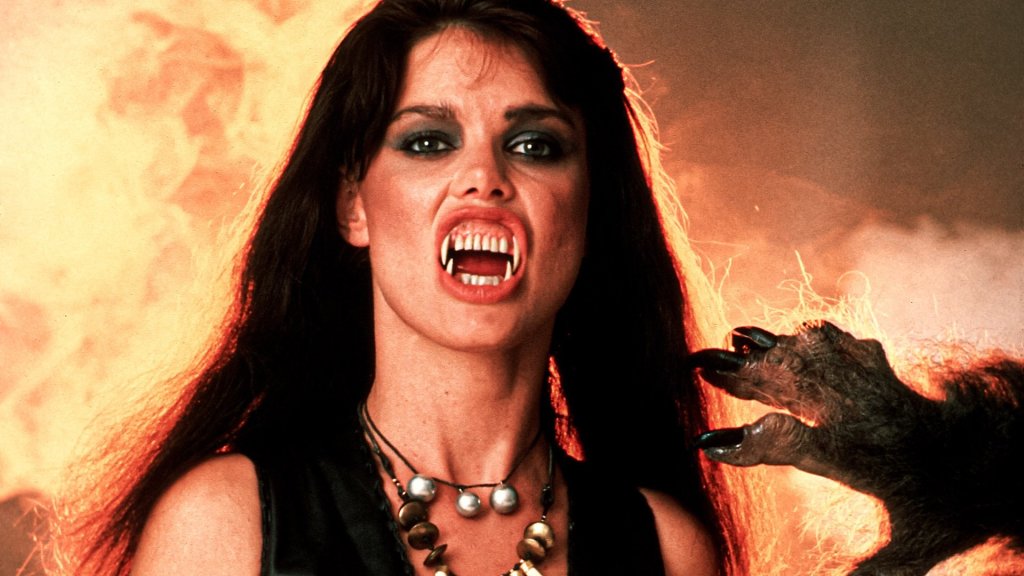
Note also the association of werewolves and sex; this had been done many times previously with vampires, but scarcely before with werewolves (although Curse of the Werewolf makes strong hints and Werewolf Woman uses lycanthropy as a metaphor). The catlike Elisabeth Brooks is ravishing; she appears nude only for a moment, but this image will surely linger long afterwards in the minds of many a viewer. Sadly, Brooks went nowhere as an actress.
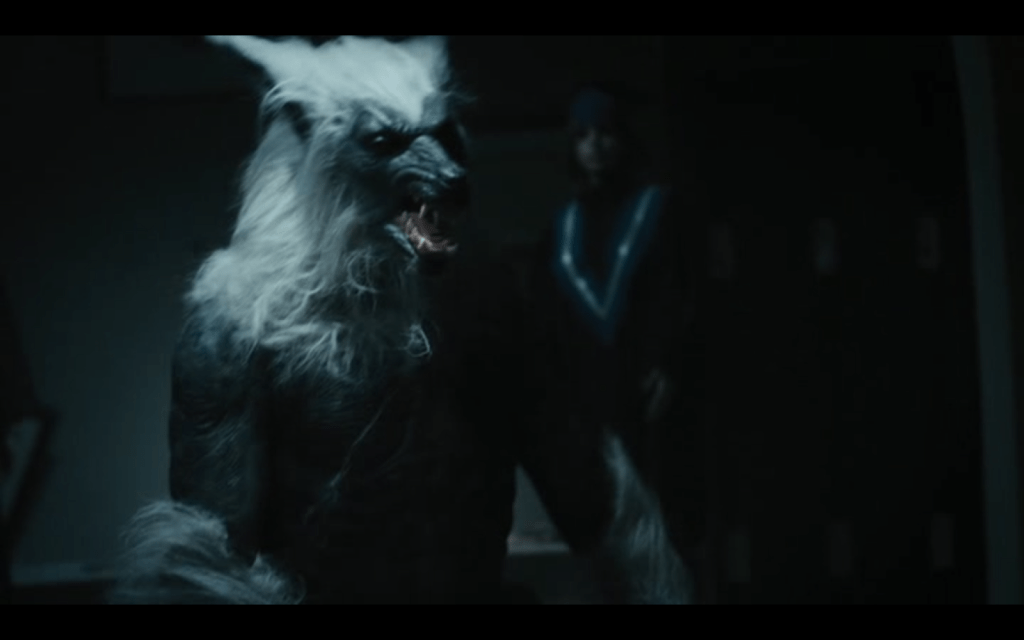
Note especially the multiple transformation scenes, courtesy of young Rob Bottin (The Thing, etc.) and his mentor Rick Baker (An American Werewolf in London, etc.). Werewolf fans like to debate which scenes are better – those here or those from An American Werewolf in London.
And I wonder if there is a sort of see-or-be-seen theme that ties things together. Our heroine is a television newscaster, told many times that she is being watched. The initial werewolf contacts her because of her occupation, and their first meeting takes place in a peep show booth. Werewolves transform when the moon is full – which is also the brightest possible night. At multiple times characters are watching television sets. Many images are shot through windows. Does the movie imply that we transform ourselves when people view us? Or do we transform when we are unseen, alone?

As with Piranha, John Sayles co-wrote the screenplay and added witty dialogue. And as with most Joe Dante movies, viewers will perceive the influence of David Cronenberg, Brian De Palma, and more. Dante admits his influences, adds humor, and doesn’t pretend. Piranha is funnier, more exciting, and has a steadier buildup to its climax. But The Howling comes close.
Action: 8. Gore: 7. Sex: 7. Quality: 8. Camp: 7.
Don’t miss: Burgers and brains
Quotable line: “Ya can’t tame what’s meant to be wild.”
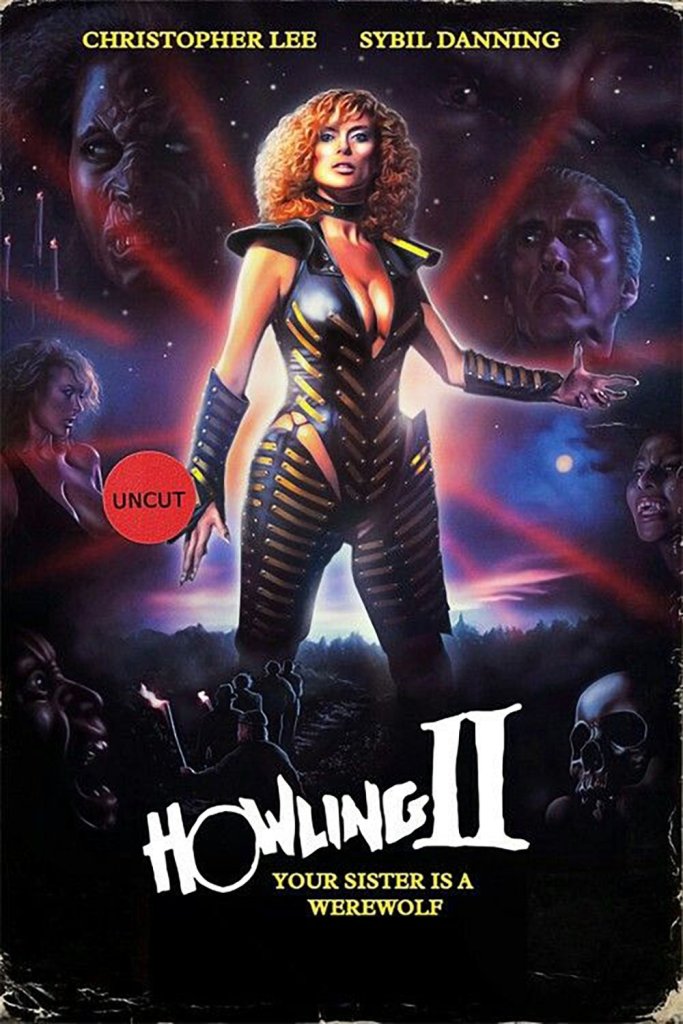
HOWLING II… YOUR SISTER IS A WEREWOLF (Phillipe Mora, 91 min uncut, color, 1985)
What’s Happening: Good guys travel to Transylvania to destroy werewolf queen and minions
Famous For: Ridiculous sequel to the Joe Dante Howling
Supposedly a sequel to The Howling (1981), and supposedly inspired by the second novel in Gary Brandner’s Howling series, the ridiculous Howling II is really a campy vampire exploitation movie mashed together with devil-worship forcing werewolves into the mix.
So here come all the cliches mashed together: secret groups of vampire-werewolf-Satanists plotting a Black Mass at the next full moon, dressing up in fetish garb, indulging in orgies, kidnapping our heroine to make her one of them, but stalked by a Van Helsing guy who uses titanium silver stakes rather than wooden stakes to keep the baddies in their coffins for good. It’s even got garlic and holy water.
Characters act as ridiculously as such concepts would imply. Our hero and heroine are so bland it’s almost a relief.
Yet unlike, say, Teen Wolf Too, this is not a sequel that people hate. It moves so quickly and throws so much gore and nudity in your face, you have to give it credit for energy. The gore and nudity comes mostly in one-second flashes, but it comes many times.
Several parts are “so bad they’re good” like when footage from the New Wave party at the beginning is spliced with the vampire orgy at the end as if it’s something new; or when you see the same transformation footage for a second, third, and fourth time; or when you see the same footage of Sybil Danning ripping off her top for a second and third time.

Somehow retaining his dignity through the nonsense is Christopher Lee in a prominent role as the Van Helsing guy. He’s best in his early scenes. The usually-likeable Reb Brown plays the hero.
The New Wave theme song is good even though we hear it 10 times. It’s like Brian Eno or Oingo Boingo.
Many scenes were filmed in then-Communist Prague, though I wish there were more establishing shots and fewer closeups.

Howling III (1987, dir. Mora, 98 min uncut, a.k.a. “The Marsupials: The Howling III” or “Howling III: The Marsupials”) is much better than II though it has no one famous in the cast.
It feels much more natural and unified than II. Once again it adds something new to the werewolf mythos – making them marsupial hybrids – but sticks with this one idea start to finish.
Unlike II it is scientific rather than supernatural, and unlike II it offers pervasive campy weirdness rather than potshots of sex and gore. Unlike II which shows transformations only in fits and flashes, III shows multiple extended transformations including an early one in a film-within-the-film and a later one in a medical lab.
It has baby werewolf puppets, and even a hairy pouch-eye-view shot with the tiny baby rolling back and forth!

I still wouldn’t call III a great film. It’s too long, has too much POV, too many sweaty closeups, and too many medical procedures.
But the audacious story (again inspired by Gary Brandner) forces us to sympathize with the werewolves and actually gets us to root for the two human-werewolf couples raising their children in the final scenes, even as the film concludes with camp. My ratings for III would be 6, 7, 5, 6, 6.
Mora also directed the excellent Beast Within (1982) whose poster (amidst lots of self-referentiality) appears in III.

Howling IV: The Original Nightmare (1988, dir. John Hough, 93 min uncut) stands alone as a character-driven horror-mystery. The heroine gets trapped in a small town populated by weirdos that we easily guess are werewolves. A religious element seems tacked on when we learn that “the Devil’s hatred for God has turned man into a habitation for demons.” Gore is almost non-existent until the famous melt scene before the climax.
I admired the seriousness of the screenplay, and I liked the confused heroine, but the whole production felt fake. Nothing felt new or inspired until the melt scene.

“Unoriginal” would have been more appropriate to the title though at least “Nightmare” admits the Elm Street influence as the heroine can’t tell reality from dream. Cut versions (c.86 min) eliminate almost all of the melting, so if you watch it be sure to watch the full version. The makeup and transformations are ok but minimal. My ratings for IV would be 5, 7, 3, 3, 3.
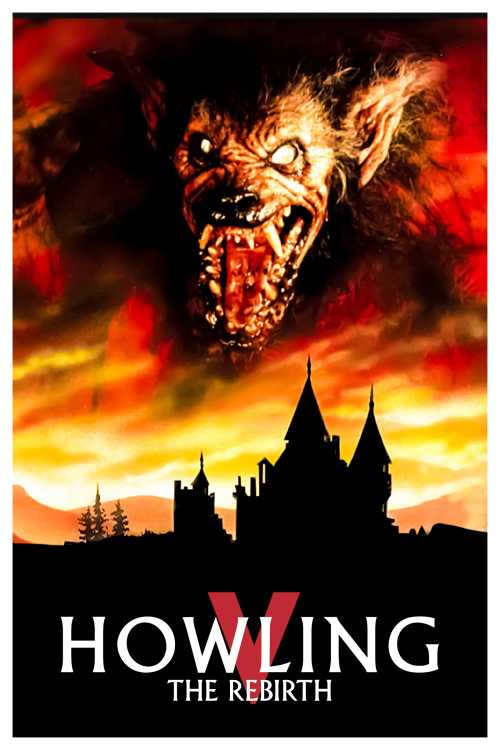
Rounding out the Howling movies of the 80s, Howling V: The Rebirth (dir. Neal Sundstrom, 96 min uncut, 1989), is a rehashing of The Beast Must Die: a large group of characters gets trapped in a castle, most of them are somehow linked, and one of them is a werewolf.

Production values are high enough, and the first third has some amusing dialogue, but the story quickly bogs itself down with characters endlessly sneaking through the castle’s rooms and catacombs, looking for each other, and arguing.

Yes, they get bumped off by the werewolf one by one, and yes there are glimpses of gore and nudity, but it’s all forced and overdone. There is no transformation sequence. At least the castle looks good in the snow. My ratings for V would be 6, 6, 5, 3, 3.
Action: 6. Gore: 7. Sex: 5. Quality: 4. Camp: 6.
Don’t miss: From Howling III: Sisters Three
Notable clue: From Howling II: “The marks found on the bodies were made by canine teeth.”
All text copyright 2025 David Elroy Goldweber
 Claws & Saucers
Leave a comment