
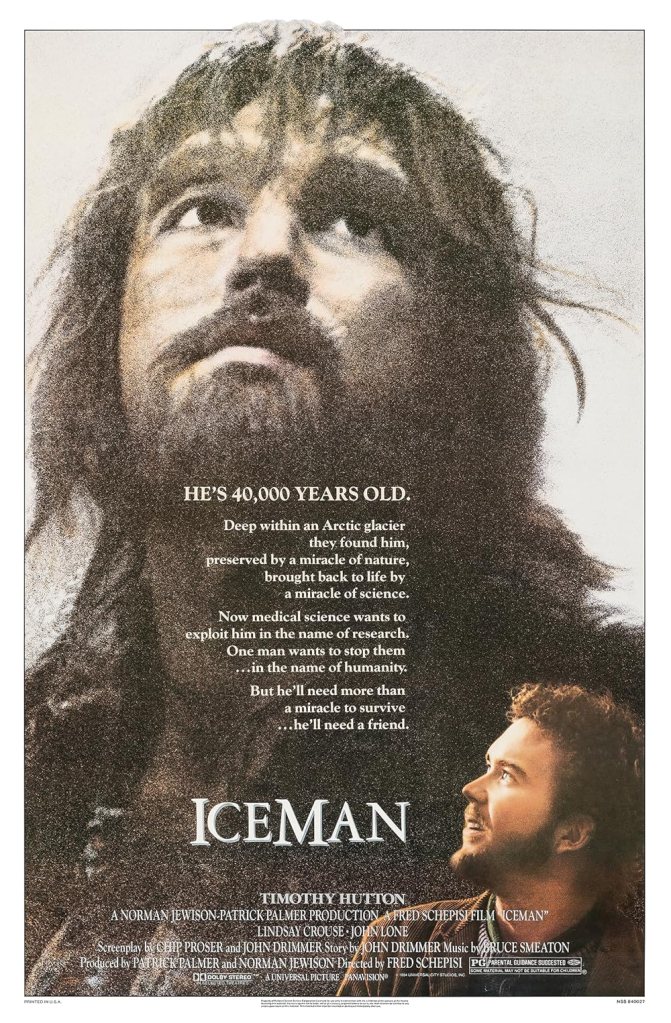
ICEMAN (Fred Schepisi, 101 min, color, 1984)
What’s Happening: Frozen Neanderthal is brought back to life
Famous For: Serious treatment of a living caveman
Living cavemen had been treated comedically in Dinosaurus! (1960) and condescendingly in Trog (1970). At last in Iceman, a living caveman is treated seriously – and successfully.
The straightforward story shows us the discovery, reawakening, befriending, and mistreatment (if inadvertent) of the 40,000-year-old hunter “Charlie.” Our present-day hero, young anthropologist Shephard, tries to understand Charlie on his own terms. But what if Charlie’s devotion to his spiritual quest outweighs everything else?
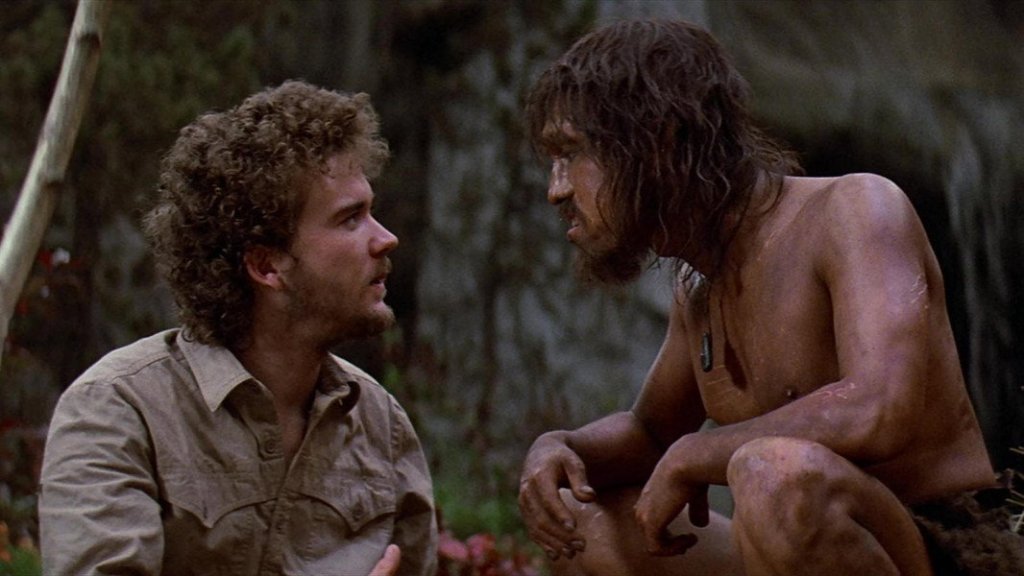
Early on, the film raises the issue of the “meaning” of the revivified caveman. Everyone except our hero sees him as a step toward the future, a means to discover how to extend life indefinitely or freeze sick people until cures can be found.
Only our hero Shephard sees Charlie as a link to our past, a way to understand how humans have evolved. Shephard also seems to be the only religious member of the research team. “Maybe [Charlie’s] spirit can teach us more than his flesh,” Shephard suggests.
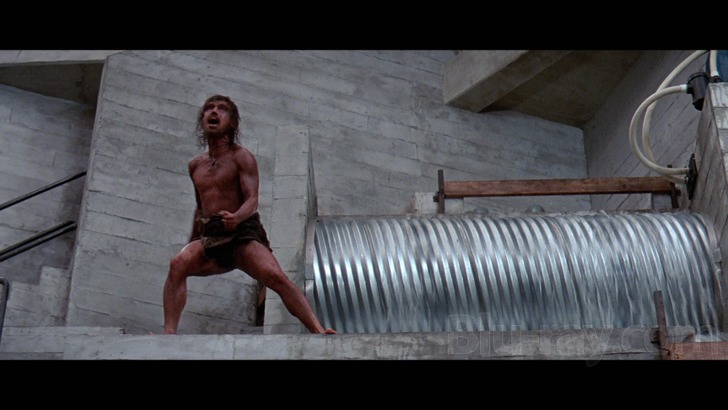
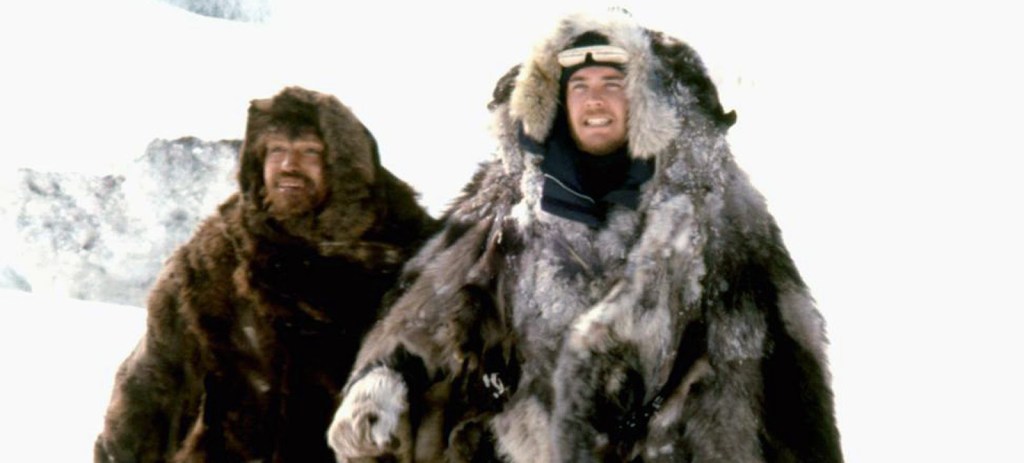
Not to take religious interpretations too far, but the Inuit quote which both opens and closes the film points specifically to a resurrection: “I, who was born to die, shall live” to bring togetherness to the world. Charlie’s devotional necklace is paired with Shephard’s cross, and we later glimpse a crucifix among Charlie’s collected objects. “Shephard” seems symbolic, not just of a caretaker who will protect Charlie rather than exploit him, but of Christ the Good Shepherd and divine guide. When Charlie prepares to sacrifice himself, Shephard even raises his arms to evoke Christ on the cross.
Timothy Hutton (only 24 at the time) makes Shephard equal parts brave and empathetic. John Lone does something similar with Charlie, as we can see he is both savage and sensitive at once. I especially liked how he pokes Shephard during their conversations to suggest that Neanderthal language is physical as much as vocal.
Iceman‘s dialogue is occasionally contrived, and the conclusion is slightly overdone, but the film as a whole is compelling and moving.
A real “iceman” (later named “Otzi”) was discovered in the Alps in 1991. Of course we can’t bring him back to life, but he remains the oldest human body ever found completely intact (c. 3200 BC). Thankfully, he’ll be kept intact indefinitely.
Timothy Hutton did Made in Heaven and The Dark Half. John Lone seems to specialize in tragic figures. He remains most famous for The Last Emperor (1987). Lindsay Crouse was the voice of the princess from Krull (1983). Danny Glover has a small role as a helpful tech. Fred Schepisi also directed the very entertaining Roxanne (1987). Producer Norman Jewison is also known as a director, with Rollerball and Cincinnati Kid among his most famous. See also Encino Man (1992).
Action: 6. Gore: 6. Sex: 2. Quality: 8. Camp: 3.
Don’t miss: Young and restless
Notable realization: “Cells metabolizing!”
Article text copyright 2026 David Elroy Goldweber. Date of post June 2026.


Leave a comment