
CLASSIC CREEPY CARNIVAL CINEMA
Carnivals have always been a little creepy. Sure, they’re places to have fun, but they always promise something weird, something grotesque, something to squirm and gawk at as part of the fun. It’s no surprise, then, that carnivals have inspired a host of excellent horror films.
I’m distinguishing carnivals from circuses, though the two are interrelated. Carnivals are more personal, more interactive, more up-close. Circuses are larger and more centralized.
You’re a spectator at a circus, but you might be a participant at a carnival – either trying your hand at a carnival game, or standing face-to-face with a carnival freak.
Here is my list of classic creepy carnival films. I pick 18 films, and most are very good. Filmmakers seem to get inspired by carnivalesque spectacle, showmanship, and thrills.


THE CABINET OF DR. CALIGARI (Germany, 1920). How about this: the very first internationally successful horror film is a carnival horror film! A carnival hypnotist named Caligari commands a somnambulist to do his bidding… and his bidding is murder!
The somnambulist appears not only to sleep but to live in a coffin. The film is not horrifying to modern audiences, but the bizarre stylized sets remain off-putting and strange. The stylization makes the whole city seem carnivalesque.
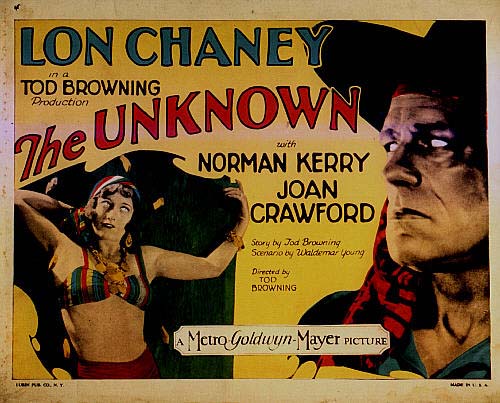
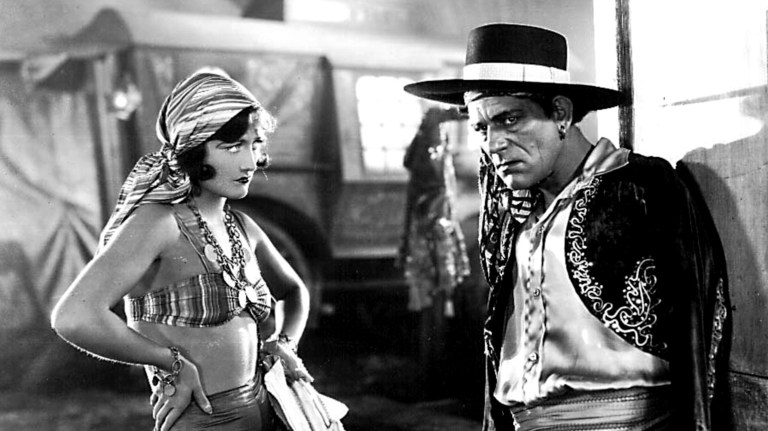
THE UNKNOWN (USA, 1927). Though Tod Browning’s Freaks is much more famous (see below), The Unknown is a better film: tighter and more focused, with no wasted moments.
As in most carnival horror films, the horror arises mostly from weird and disturbing ideas – not from shocks or gore. Our anti-hero Alonzo, played with relish by the great Lon Chaney, pretends to be armless to impress the woman he loves… but eventually becomes so skilled with his legs and feet that he considers getting his arms amputated on purpose for real!
Many scenes unfold within carnival wagons or tents.


THE MAN WHO LAUGHS (USA, 1928). Conrad Veidt, who played the somnambulist in Cabinet of Dr. Caligari (see above), here plays the hapless Gwynplaine, a carnival freak whose face was surgically altered during boyhood to exhibit a permanent twisted grin. (He inspired The Joker.)
It’s a tragic romance, emotionally intense, with 17th-century carnival atmosphere. Get in the mood for melodramatic silent-era acting, and you’ll enjoy it immensely.


FREAKS (USA, 1932). It’s technically a circus film but it’s all about the sideshow, and a sideshow is basically a carnival. Writer-director Tod Browning had spent his younger years working in circus sideshows, and he developed sympathy and affinity for the myriad human oddities (“freaks”) he encountered.
The film is clearly sympathetic to the freaks – all the freaks are heroic and the one beautiful “normal” woman is villainous – but it has a horror atmosphere and a high camp horror coda.
Audiences in the 30s were disgusted, and the film was suppressed for an entire generation before it remerged in the 1960s. It’s only about an hour, so it should be high on your creepy carnival film list.


NIGHTMARE ALLEY (USA, 1947). This is Film Noir, but unlike virtually all other Noir films it’s a tiny bit supernatural, as the anti-hero is a tiny bit psychic.
Like other classic Noir protagonists, he’s rather amoral, willing to use and abuse others, willing to tell untruths to make his way in the world. And as in other classic Noir films, the world around the protagonist also seems corrupt – with sham psychics and assorted swindlers using the carnival to milk the gullible public for every cent they can get.
Carnival “geeks” bite the heads off live chickens as our anti-hero watches in morbid fascination. Quality-wise, this is probably the best film on our list.


GORILLA AT LARGE (USA, 1954). Here’s the least famous film on our list, yet it features the most famous cast: Raymond Burr, Anne Bancroft, Cameron Mitchell, Lee J. Cobb, and Lee Marvin, all in one film.
A skeevy carnival boasts a killer gorilla named Goliath but also a substitute guy in a gorilla suit. When carnival workers start showing up dead, whodunit – the real gorilla or the fake one?
A late scene in a mirror maze is good but was probably even better in the film’s original 3D. Well worth the watch.


NIGHT TIDE (USA, 1961). It’s technically a Santa Monica boardwalk movie, but boardwalks are pretty close to carnivals, right? Dennis Hopper, in one of his first starring roles, falls in love with a smoldering carnival beauty who might be an evil siren.
Is she really supernatural? Or is the hero just confused by obsession and lust? The minimalist b&w atmosphere predates Carnival of Souls.


CARNIVAL OF SOULS (USA, 1962). You probably know this one already, but how could I exclude it from the list? It’s a strange hallucinogenic experience, and alongside Night of the Living Dead and Spider Baby it’s one of the top three independent horror flicks of the 60s.
Many fun documentaries (on YouTube and elsewhere) chronicle the Saltair resort in all its carnival glory.


THE INCREDIBLY STRANGE CREATURES (USA, 1964). If you don’t know this film’s full title, go ahead and look it up on the IMDb since it’s reportedly the longest ever title for a feature film.
While the title and the movie are filled with gimmicks, the carnival (boardwalk, amusement park) atmosphere is continuous and powerful. Watch as a sideshow astrologer turns unsuspecting victims into “mixed-up zombies.” Will our hero escape?
Three quarters of the movie plays at the boardwalk carnival, and one quarter plays in a little theater where 60s lounge singers croon songs in their entirety. The cheapness and unselfconsciousness of the farrago is part of the fun.


SHE FREAK (USA, 1967). For the highest percentage of real-life carnival footage, see She Freak.
It’s mostly an exploitation film (and a fairly mild one from the co-creator of Blood Feast), but it can’t help show its love for carnivals – the rides, the games, the food, the barkers, and of course the sideshows and freaks. Several scenes have no dialogue; it’s just straight carnival footage with 60s tunes playing overhead.
To gain money and power, our anti-heroine shamelessly manipulates the men around her at the carnival, but what if her plans backfire? The conclusion is an homage to Freaks. Remember, there are two kinds of freaks: “those created by God… and those made by Man.”


TORTURE GARDEN (England, 1967). Amicus Productions made a dozen horror anthology films in the late 60s and early 70s. The fearless Torture Garden might be their best.
Five carnival visitors pay an extra fee to Dr. Diablo (Burgess Meredith) at a carnival sideshow to see their own futures. Each future (each story) is very strange. Scenes inside the carnival tent provide the frame tale. Are these viewable futures mere carnival hypnotism? Or is Dr. Diablo really privy to our fates?
I generally dislike anthology films, but Torture Garden is one of the few that I love. Actually, how can anyone not love a film featuring Jack Palance and Peter Cushing attacking each other after arguing about Edgar Allan Poe?


CARNIVAL OF BLOOD (USA, 1970). While other carnival movies are set in California (like Incredibly Strange Creatures or She Freak), Carnival of Blood sets itself in the most famous carnival on the East Coast: the Coney Island boardwalk.
And better yet, it’s the Coney Island boardwalk in 1970, a decade past its prime but two decades before the last vestiges of old-time freakishness were cleaned away in the 1990s.
Someone is murdering people at the boardwalk, but who? The film itself is awful – offering occasional gore but drowning itself in endless meandering conversations. Still, several colorful characters are sure to stick with you, including Drunken Sailor, Bespectacled Termagant, Gypsy Psychic, and Teddy Bear Dart Guy.
Burt Young, who plays the wonderful scarred retarded hunchback Gimpy, later played Paulie in Sylvester Stallone’s Rocky series.
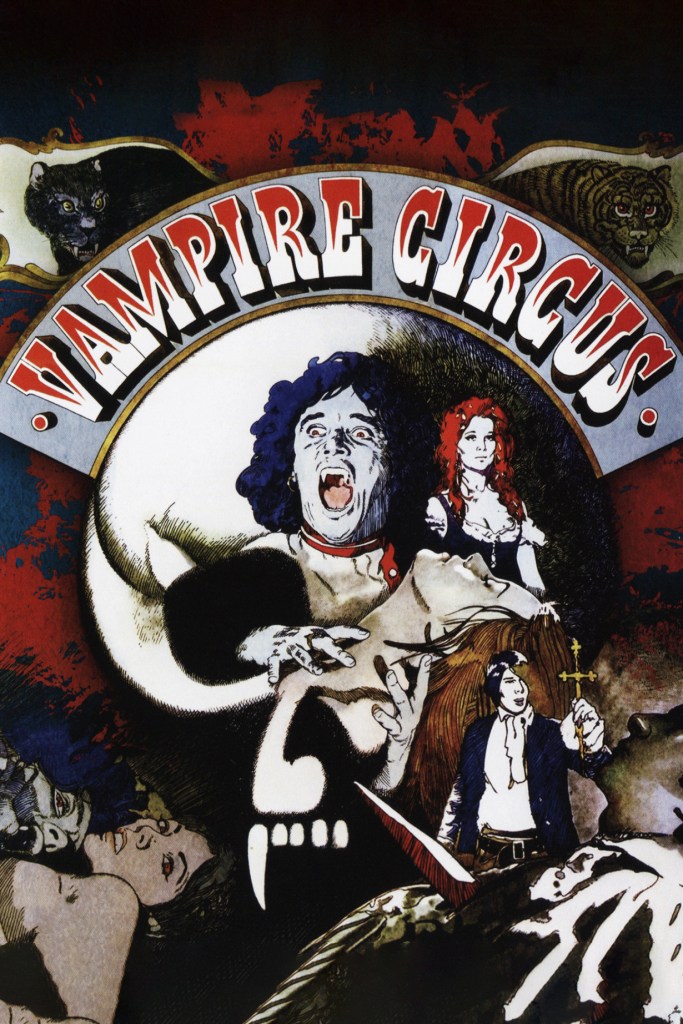
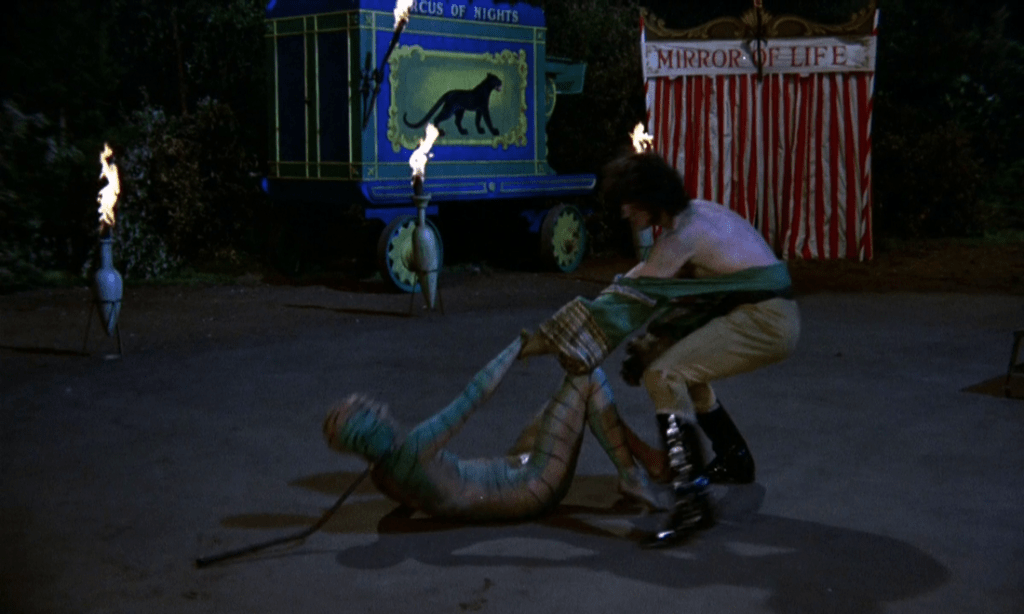
VAMPIRE CIRCUS (England, 1972). It says “circus” but the travelling acts really constitute a carnival, complete with fortune tellers and a hall of mirrors.
A cursed village is pleased to get a visit from the carnival… but will the performers help them or destroy them? The famous Hammer Studios was in decline when it made the film, and the studio was adding exploitative nudity to its new releases in an effort to save itself.
The studio finally closed in the late 70s, but Vampire Circus is one of its more memorable pandering productions, if only because one of the circus performers is a nude dancer in tiger-stripe body paint (!). The Victorian atmosphere (always Hammer’s greatest strength) is strong.


MALATESTA’S CARNIVAL OF BLOOD (USA, 1973). Unknown for decades but slowly emerging from obscurity is this very fun exploitation flick featuring Herve Villechaize in a small but memorable role as “Bobo” the evil dwarf.
Actually everyone is evil at this dilapidated carnival amusement park where unsuspecting visitors are dragged into hidden underground caves and eaten by cannibals.
So it’s a cannibal carnival. It’s got good low-budget gore and some strong psychedelic carnival atmosphere.
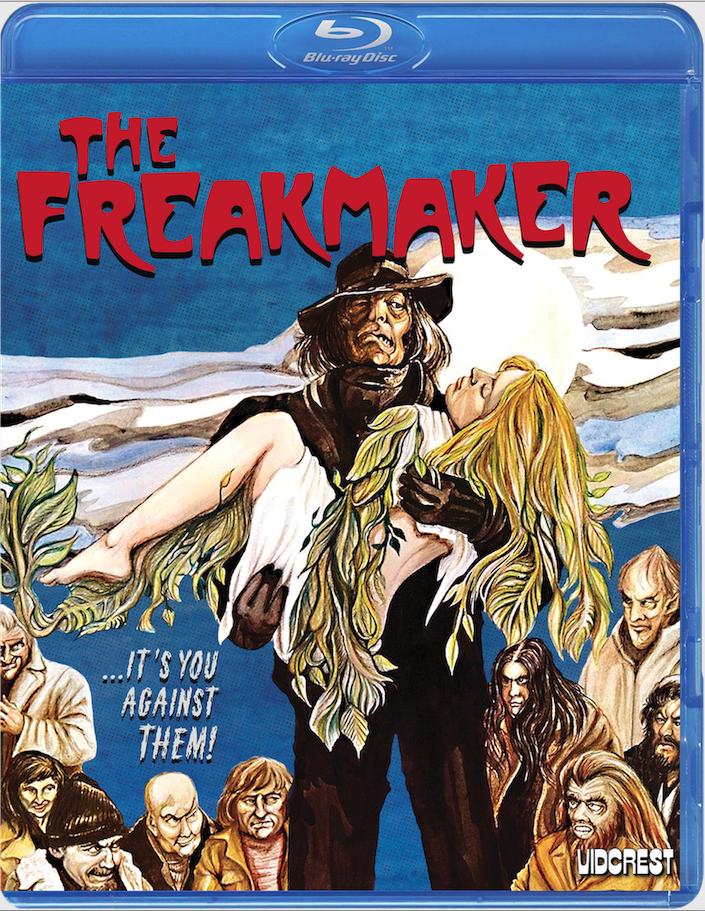

THE FREAKMAKER (England, 1974, a.k.a. “The Mutations”). With Donald Pleasence playing a mad scientist intent on turning gullible college students into plant-human hybrids, and with Tom Baker in “Elephant Man” makeup playing Pleasence’s trusty assistant/thug, it’s a fair bet that The Freakmaker is pretty intense.
Key scenes unfold in a university or an urban park, but the traveling carnival and sideshow give us the (sympathetic) freaks who just might have to save the day.
Several real-life human oddities appear in the film, including Alligator Girl, Pretzel Boy, and Popeye – who can pop his eyes halfway out of his head. Be ready for some weird nudity and gore too.


THE FUNHOUSE (USA, 1981). I think this one is overrated, maybe because I expected more from Chainsaw Massacre director Tobe Hooper, but I love how it lets us behind the scenes more than most other carnival movies.
We creep past the mechanisms inside the rides, we lurk backstage in tents and trailers. Several of the workers – especially the guy who never removes his Frankenstein mask – harbor deadly secrets. Can any of our oversexed teens escape alive?


DEATH SCREAMS (USA, 1982). A carnival figures into the first third of this little-known low-budget slasher, but it probably should have been the setting for the whole thing. It’s entertaining to see the teens (familiar slasher movie types) in their 80s outfits joking around, chomping carnival food, and hitting some games and rides.
The movie as a whole is confusing and poor, and the best slasher stuff (killings) happens toward the end, but carnival fans should at least try the first 30-40 minutes. It’s North Carolina for a change.


SOMETHING WICKED THIS WAY COMES (USA, 1983). Claws & Saucers usually stops at 1982, but 1983’s Something Wicked might have the best creepy carnival of them all.
It’s only a little weird when the mysterious travelling carnival first arrives in the small Midwestern town. Then it gets a little more weird, and a little more, and even more as townspeople are tempted to sacrifice their principles to slake their temporal desires.
Eventually, the entire town seems imperiled by the stone-faced carnival players and their suavely evil master, Mr. Dark. Two young boys (and eventually one boy’s father) recognize the danger. But is it too late?

Article text copyright 2026 David Elroy Goldweber. Date of post May 2026.


Leave a Reply